By
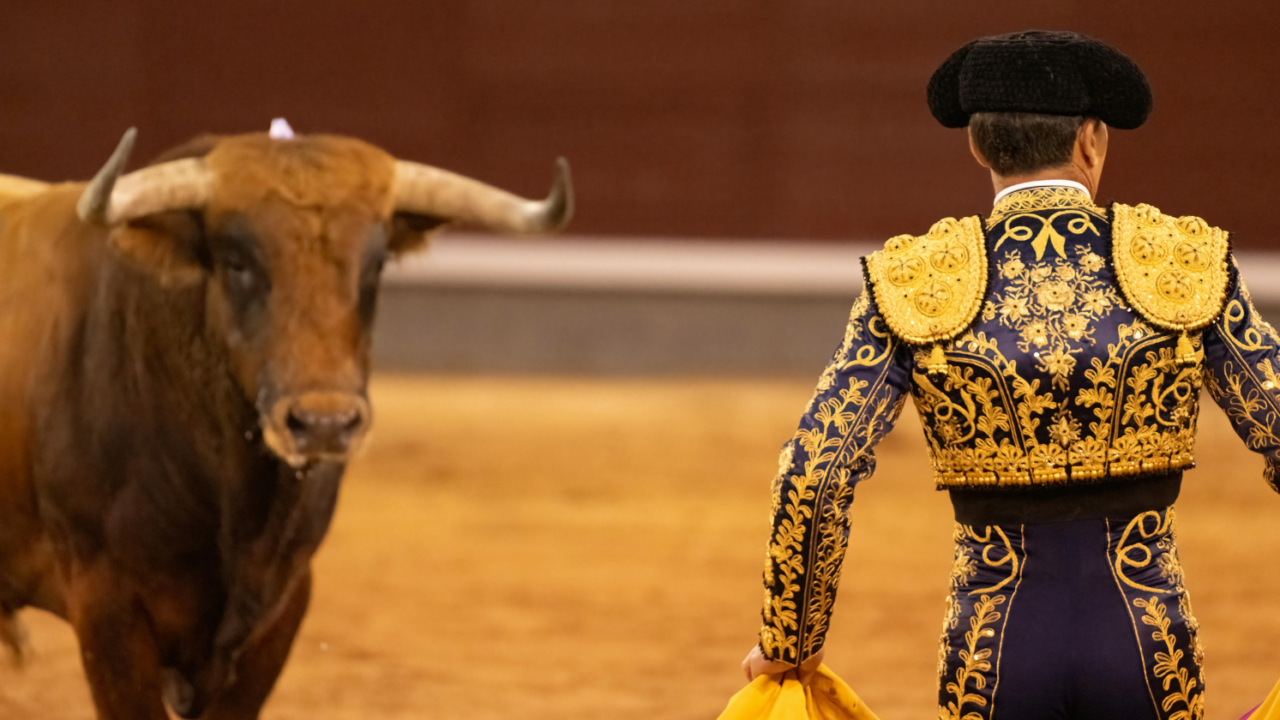
On a ranch near Córdoba in southern Spain, in 1963, a slim man in a sweater stepped into a bullring. He wasn’t a matador. He carried no sword, only a red cape and a small box with buttons on it.
A fighting bull, bred for aggression, lowered its head and charged. The man pressed a button. Just a few feet away, the bull skidded to a stop, turned aside and trotted off.
The scientist in the ring
The man was José Manuel Rodríguez Delgado, a Spanish-born neuroscientist who worked at Yale University in the United States. He was fascinated by a bold question: could behaviour be changed by stimulating specific parts of the brain with electricity?
Delgado had invented a device he called a “stimoceiver”. It combined tiny electrodes implanted in the brain with a radio receiver. Using a hand-held transmitter, he could send electrical pulses to the electrodes from a distance, while the animal moved freely.
A challenge from a bull breeder
The bull experiment began with a dare. A bull breeder in Córdoba told Delgado that his electrodes might work in cats and monkeys, but they would never stop a fighting bull.
Delgado took up the challenge. He implanted electrodes into the brains of several bulls, targeting a region called the caudate nucleus, part of a group of structures deep in the brain that help control movement. Then he tested the effects by stimulating different points while the animals were in the ring.
Stopping the charge
In the most famous demonstration, Delgado waved a cape to provoke a bull into charging. As it bore down on him, he pressed the button on his transmitter. The bull stopped and turned away.
Delgado filmed the experiment, and the footage still exists. In 1965, the story reached the front page of The New York Times, which called it a spectacular demonstration of controlling animal behaviour through the brain. Delgado became famous almost overnight.
Calming the bull, or just turning it?
Delgado claimed the stimulation did more than physically stop the bull. He said it reduced the animal’s aggressive drive, and that repeated stimulation made some bulls less aggressive for a time.
Other scientists weren’t so sure. Because the caudate nucleus helps control movement, critics argued the stimulation may simply have forced the bull to turn, rather than changing how it felt. Delgado himself later described the effect as a combination of the two: a motor effect that made the bull stop and turn, plus some reduction in aggression. Details of the experiments were never fully published in major scientific journals, which has made them hard to evaluate. A 2017 article by Timothy Marzullo describes tracking down Delgado’s own detailed Spanish account of the bull experiments.
Fears of mind control
Delgado also tested his methods in monkeys and in human patients with conditions such as epilepsy. He found that stimulating certain brain areas could trigger movements, emotions and changes in behaviour.
His work alarmed many people. In his 1969 book Physical Control of the Mind, Delgado argued that brain stimulation could one day help create a happier, less violent society. Critics saw it as a step towards mind control and raised serious ethical concerns. In 1974, amid controversy, he moved back to Spain to help set up a new medical school in Madrid.
A complicated legacy
Today, Delgado is remembered as both a pioneer and a cautionary figure. His experiments helped show that electrical signals could change brain activity and behaviour in living animals.
Modern deep brain stimulation, which uses implanted electrodes to treat conditions such as Parkinson’s disease, works on related principles, though it’s far more carefully controlled and tested. As a 2022 review of his work noted, Delgado’s devices were early forerunners of today’s brain stimulation technology. The image of a scientist stopping a charging bull with the press of a button remains one of the most striking moments in the history of neuroscience.