By
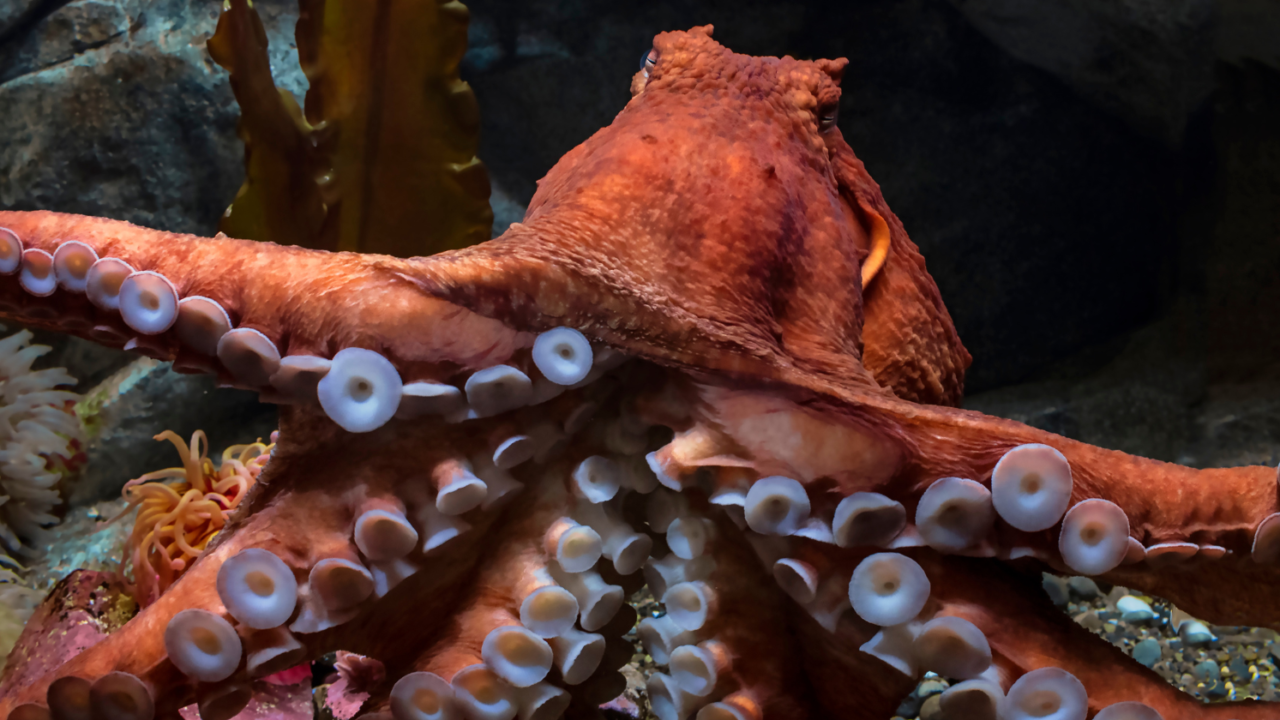
An octopus arm, cut off from its body, will still reach out and grab things.
That's not a horror-film exaggeration. It's a well-documented laboratory finding, and it says a great deal about one of the strangest nervous systems on Earth.
Where are all those neurons?
A common octopus has roughly 500 million neurons. That's similar to a dog, and far more than any other invertebrate.
But most of them aren't in its head. About 350 million, roughly two-thirds, sit in the eight arms. Each arm has its own thick nerve cord running down its length, studded with clusters of nerve cells that act a bit like mini-brains. The central brain, including the large lobes that process vision, holds about 170 million.
The connection between the two is surprisingly thin. The bundle of nerve fibres linking the central brain to the arms has far fewer neurons than either end. In other words, the brain and arms aren't constantly chatting. Much of the work happens locally.
Can an arm really work on its own?
In a classic 2001 study, neuroscientists at the Hebrew University of Jerusalem looked at one of an octopus's most common movements: reaching out an arm towards a target.
They found they could trigger that same reaching movement in arms that had been completely separated from the brain, just by touching or electrically stimulating them. The movements looked almost identical to normal behaviour.
The conclusion was striking. The basic program for reaching isn't stored in the octopus's brain at all. It's built into the arm itself. The brain seems to give a rough instruction, something like "reach over there", and the arm works out the details.
That's a clever solution to a hard problem. An octopus arm has no bones and can bend in practically any direction. Controlling every part of all eight arms from one central brain would be enormously complicated. Handing much of that job to the arms makes it far simpler.
How does an arm "taste"?
Octopus suckers do more than grip. They also taste what they touch.
In a 2020 study at Harvard, Lena van Giesen and Nicholas Bellono identified the cells behind this "taste by touch" system. Embedded in the suckers is a family of sensors, found only in cephalopods, that respond to chemicals that don't dissolve well in water. That's exactly the kind of chemical you'd find on the surface of a crab or a snail.
That lets an arm tell the difference between a rock and a meal simply by touching it. As Bellono put it, the arm can effectively register that it isn't just touching something, it's touching a crab. The arm can then decide whether to grab hold, often without the central brain getting involved.
Why don't the arms grab each other?
There's an obvious risk with arms that act this independently. With hundreds of sticky suckers moving at once, what stops an octopus from grabbing itself?
In 2014, the same Jerusalem team tested severed arms and found they would firmly grab almost any object for more than an hour. The exceptions were octopus skin: the arm's former owner, other live octopuses and other severed arms.
But when the researchers peeled the skin off a severed arm and offered it to another arm, the second arm grabbed it like anything else. Something in octopus skin seems to stop suckers from latching on, a built-in "don't grab me" signal that works without any thinking required.
Is each arm its own mind?
It's tempting to picture an octopus as nine brains loosely sharing one body. That's not quite right either.
The central brain still matters. It handles vision, learning and overall decisions, such as where to hunt or when to flee. And octopuses can coordinate their arms to do remarkably complex things, from opening jars to carrying coconut shells to hide in.
A better picture might be a manager and eight very capable staff. The manager sets the goal. The arms handle the details, adjusting grip, tasting what they touch and avoiding each other, without needing to report back on every move.
A different way to build intelligence
Octopuses and humans last shared an ancestor more than 500 million years ago, probably a simple worm-like creature. Since then, the two lineages have evolved complex brains completely separately.
That's what makes the octopus so valuable to neuroscientists. It shows there's more than one way to build a clever animal. Human intelligence is concentrated in one place, while the octopus spreads it through its body.
Scientists still don't fully understand what it's like to be an octopus, or whether its arms experience anything at all. But every new study makes it clearer that intelligence doesn't have to live only in a head.