By

You’re at a party, surrounded by people you know. Someone tells a story and the whole group laughs. You smile along, but something feels off. You didn’t find it that funny, and you’re not sure why everyone else did.
Many lonely people describe this feeling, of being alone even in a crowded room. A study using brain scans suggests it may reflect something real about how their brains respond to the world.
Students, videos and a brain scanner
In a study published in 2023 in Psychological Science, neuroscientist Elisa Baek, then at UCLA, and colleagues including Carolyn Parkinson recruited about 70 first-year university students living in shared residences.
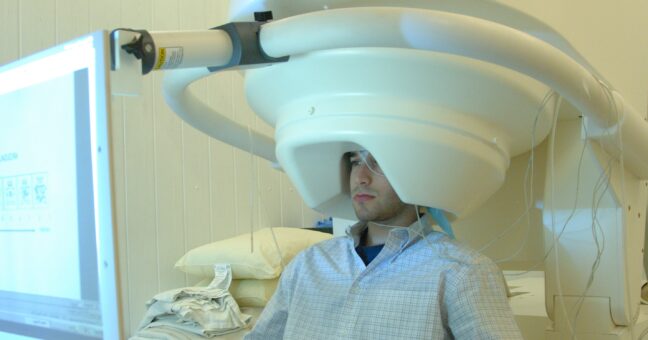
Each student lay in an fMRI scanner and watched 14 video clips in the same order. The clips covered a wide range of content, from emotional scenes to comedy and music videos. Afterward, the students filled out the UCLA Loneliness Scale, a standard questionnaire about feelings of social connection.
The researchers then split the group in two, those who scored above the middle on loneliness and those below, and compared how similar each person’s brain activity was to everyone else’s as they watched.
“Happy families are all alike”
The results followed what the researchers called the Anna Karenina principle, after the famous opening line of Leo Tolstoy’s novel: “Happy families are all alike; every unhappy family is unhappy in its own way.”
Students who weren’t lonely showed brain responses that were strikingly similar to one another. Lonely students showed responses that were dissimilar to those of their peers. And surprisingly, they weren’t similar to each other either. Each lonely person seemed to process the videos in their own idiosyncratic way.
Baek said it was surprising to find that lonely people were even less similar to each other than to everyone else.
Not about how many friends you have
The effect didn’t simply come down to social life. The link between loneliness and unusual brain responses held even after the researchers accounted for how many friends people had in their residence.
In other words, someone could have plenty of friends and still feel lonely, and still show a brain that responded differently from the people around them.
Where the differences showed up
The biggest differences appeared in the default mode network, a set of brain regions that includes parts of the cingulate cortex along the brain’s midline. This network becomes active when we think about ourselves, other people and the meaning of what’s happening around us.
Earlier research from Parkinson’s lab found that close friends tend to show very similar brain responses in these regions when watching the same videos. Similar responses here have been linked to shared perspectives and a sense of understanding one another. When your brain interprets a scene the way your friends’ brains do, you’re more likely to “get” each other.
Lonely people may miss out on that feeling. As the researchers put it, processing the world idiosyncratically may contribute to the reduced sense of being understood that often comes with loneliness.
Chicken or egg?
The study can’t say which comes first. Seeing the world differently could make it harder to feel connected, leading to loneliness. Or loneliness could change how people pay attention to and interpret the world.
Other research suggests the second idea is possible. The late psychologist John Cacioppo, a pioneer of loneliness research, proposed that loneliness puts the brain on alert for social threats. In one of his brain imaging studies, lonely people showed weaker responses in the brain’s reward system when viewing pleasant pictures of people, suggesting social scenes may feel less rewarding to them.
It’s likely the relationship runs both ways, with each effect feeding the other.
Finding common ground
The findings also hint at hope. If loneliness is partly about not feeling understood, then building shared understanding may help, and that doesn’t necessarily require more friends.
Talking openly about how you see things, seeking out people with shared interests, and taking time to understand others’ perspectives may all help bridge the gap.
The study was relatively small and involved only university students, so more research is needed. But it offers a powerful insight into one of loneliness’s most painful features. Sometimes the problem isn’t that nobody is there. It’s feeling that nobody sees things the way you do.