By
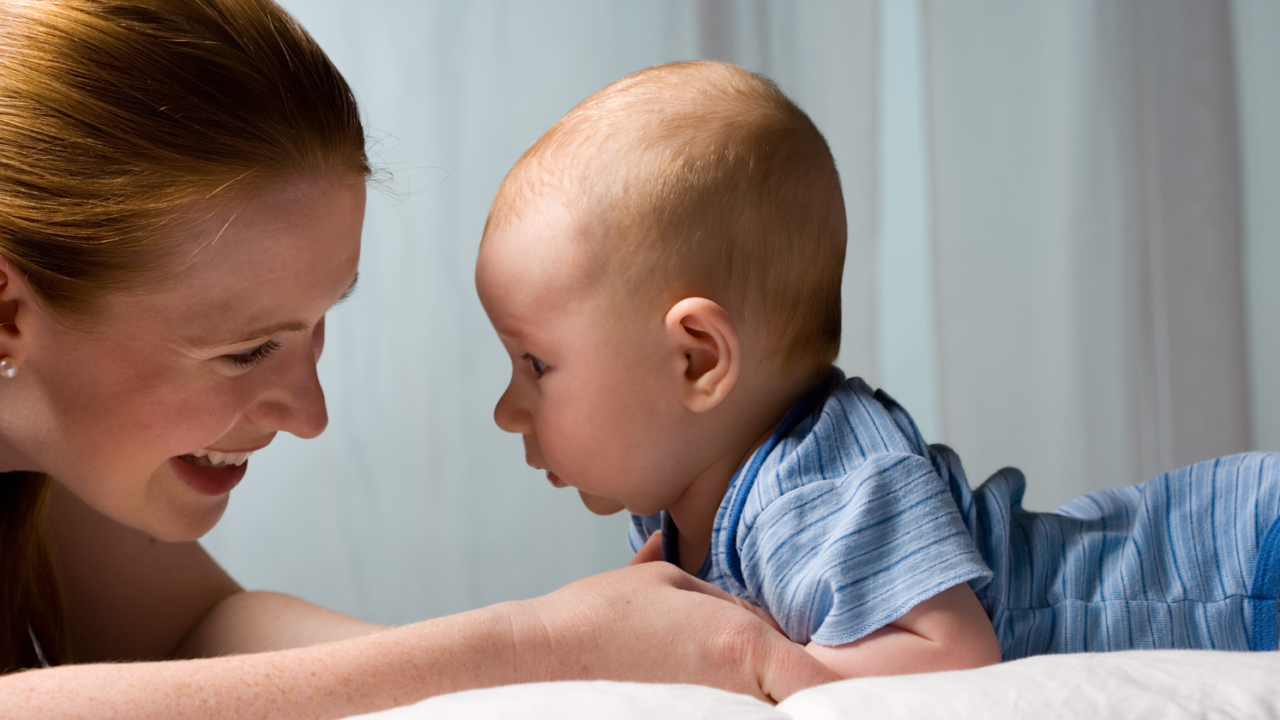
You’re singing a nursery rhyme to a baby on your lap. She’s watching your face intently, and when your eyes meet, she lets out a little “aah,” as if she has something to add.
It feels like a moment of connection. Research from the University of Cambridge suggests it may be more than a feeling. When adults and babies lock eyes, their brain activity starts to move in sync.
Brains in step
When people communicate, their brains can become partly synchronized. Studies in adults have found that when one person speaks and another listens, patterns of activity in the listener’s brain can start to track the speaker’s, especially when they understand each other well.
But researchers knew far less about babies. Can an infant’s brain synchronize with an adult’s? And what might help it happen?
To find out, psychologists Victoria Leong and Sam Wass, working in Cambridge’s Baby-LINC Lab, designed two experiments. They used electroencephalography, or EEG, which records the brain’s electrical activity through small sensors in a soft cap.
Experiment one: a singing video
In the first experiment, 17 infants watched videos of an adult singing nursery rhymes. The adult’s brain activity had already been recorded while she sang.
In some videos, she looked straight at the camera, so she appeared to be looking directly at the baby. In others, she turned her head and eyes slightly away. In a third version, her head was turned away, but her eyes still looked straight at the baby.
The infants’ brain waves synchronized more with the adult’s when she looked directly at them. The strongest effect came when her head was turned but her eyes looked back at the infant, perhaps because that kind of gaze seems especially deliberate.
Experiment two: a real person
In the second experiment, 19 infants sat with a real adult, who sang nursery rhymes while either looking directly at them or looking slightly away. This time, the researchers recorded brain activity from both the adult and the infant at the same time.
The results went both ways. When the adult made direct eye contact, the infant’s brain activity became more coupled to the adult’s, and the adult’s brain activity became more coupled to the infant’s too. The babies were influencing the grown-ups as well as the other way around.
Babies who “talk back”
The researchers also counted how many sounds the babies made. Infants made more vocalizations when the adult looked directly at them, a sign, the team suggested, that they were trying harder to communicate.
There was another link. Babies who made longer vocalizations tended to draw stronger synchronization from the adult’s brain.
Leong explained that when an adult and infant look at each other, they’re signaling that they’re available and ready to communicate. The synchronized brain state, she suggested, may help prepare them to take turns, knowing when to speak and when to listen, which could make learning easier.
Wired to notice eyes
Babies seem built to pay attention to eyes from the very start. Earlier research has found that newborns only days old prefer to look at faces gazing directly at them rather than faces looking away.
Faces and eye contact are processed by specialized brain networks, including the fusiform face area, which helps us recognize faces, and the amygdala, which helps flag socially and emotionally important signals. Eye contact may act like a spotlight, telling a baby’s brain that this moment, and this person, deserves attention.
Not telepathy
The researchers were careful about what their findings mean. As Wass put it, they weren’t claiming to have discovered telepathy. Brain waves can fall into step because two people are responding to the same sounds and signals at the same time, such as the rhythm of a song or the timing of a smile.
The study was also small, and the babies watched or listened to a stranger, not their own parents. The team still needs to figure out exactly how eye contact and vocalizations produce the synchrony.
Still, the results support something many parents already sense. A shared look with a baby isn’t just a sweet moment. It may help two brains get in step, laying some of the groundwork for the conversations to come.