Reference entry The Brain
Most of what we “know” about Phineas Gage was written after he died. The real story says more about how people recover from brain injuries.
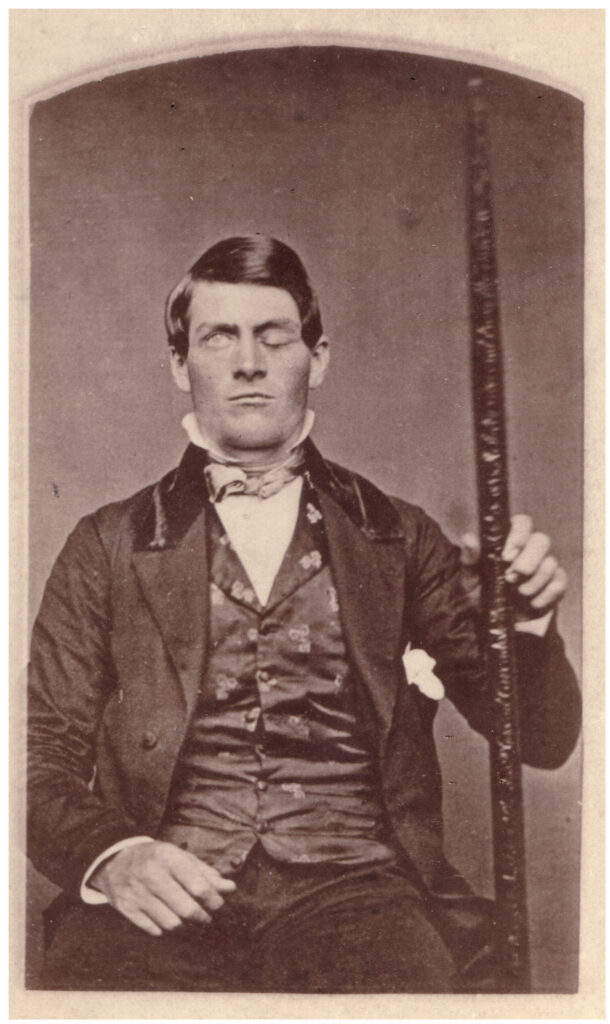
If you've ever opened a psychology textbook, you've probably met Phineas Gage. He's the railway foreman who, in September 1848, had a three-and-a-half-foot iron rod blasted up through his left cheek and out of the top of his skull, survived, and then became a different man. His friends said he was "no longer Gage", and for more than 150 years he's been the go-to example of how damage to the front of the brain can change who you are, for good.
That story hasn't stayed in the history books. People living with frontal lobe injuries today are still read through it, and some of them are pushing back. Callum, a brain injury survivor who worked alongside writer Ben Platts-Mills at Headway East London, a community centre for survivors, looks back on the out-of-character things he did after his own injury and refuses to put them down to a broken brain. "I'm me after something traumatic has happened to my brain," he says in Platts-Mills's essay for Aeon. "It was me who was disinhibited."
Which is why the part of Gage's life most textbooks skip matters so much. In August 1852, four years after the accident, he sailed to Chile to work for a new stagecoach line. His doctor, John Harlow, wrote in his 1868 follow-up that Gage spent his years there "caring for horses, and often driving a coach heavily laden and drawn by six horses." That isn't a job you give to someone who can't plan ahead, keep his temper, or turn up on time.
Life on the Valparaíso road
Malcolm Macmillan, the Australian psychologist who spent decades digging through the Gage records, has pieced together what the work involved. The run between the port of Valparaíso and the capital, Santiago, was around 100 miles of poor road and took about 13 hours. As Platts-Mills sums up Macmillan's description, it meant "rising in the small hours, loading passengers' luggage and possibly handling fares", keeping six horses under control, and steering a heavy coach along a crowded and sometimes dangerous road, all in a new country with a new language to pick up.
An American who knew Gage in Chile in 1858 and 1859 reported in 1860 that he was still driving stagecoaches and was "in the enjoyment of good health, with no impairment whatever of his mental faculties." He's often called a visiting physician, but Macmillan's research lists him as a druggist named Henry Trevitt, so it's a friend's word rather than a medical verdict.
Gage's health eventually gave out. He left Valparaíso in 1859 to join his mother and sister in San Francisco, started having seizures the following February, and died on 21 May 1860, aged 36. Harlow's account puts everything a year later, which is why his "nearly eight years" in Chile was really closer to seven.
How the legend outgrew the man
So why does almost nobody know this? Part of the answer came out at the end of last year, when Manon Auffret, a researcher linked to Rennes University Hospital in France, published a study in the Journal of the History of the Neurosciences. She searched digitised newspaper archives for every US report about Gage between 1848 and 1899 and found 831 of them. A full 72% were published after he died. Most of his story was told when he was no longer around to contradict it, and Auffret also turned up previously unknown sources that she says provide "new evidence of Gage's functional recovery".
The modern retellings haven't helped. When University of Florida psychologist Richard Griggs checked 21 psychology textbooks that covered Gage in 2015, only four mentioned Chile. In a 2022 analysis of 25 scientific papers, Stephan Schleim of the University of Groningen found 13 described psychopath-like behaviour, and only four mentioned that Gage went on to a stable working life. Macmillan and Berkeley psychologist John Kihlstrom put it bluntly: "None of this psychopathic-like description is true." The changes were real, they write, but "they were neither so extensive nor were they permanent." We go through how that myth grew in more detail in our video on Gage.
Gage wasn't the last
None of this means frontal lobe injuries don't change people. Some of the cases that came after Gage show it far more clearly than he ever did.
In 1985, neurologists Paul Eslinger and Antonio Damasio described a patient known as EVR, who had lost part of the underside of both frontal lobes during brain surgery. On paper, he was fine. His measured intelligence was superior and his neurological tests were otherwise normal. In real life, he couldn't keep up with his personal or work responsibilities, and those changes were still there eight years later. Because his test scores looked so good, he was written off as a "malingerer". Anyone living with a brain injury that doesn't show up on the outside will probably recognise that.
The biggest picture comes from the Vietnam Head Injury Study, which followed American veterans who came home with penetrating head wounds. In a 1996 report in Neurology, Jordan Grafman and colleagues compared 279 of those veterans with 57 who hadn't been injured, using ratings from family and friends 10 to 15 years after their injuries. Damage to the lower and middle front of the brain did raise the risk of aggression. But the authors stressed that "not all patients with these lesions had such behavior", and the aggression they did see was "more weighted towards verbally aggressive than physically violent behavior." Family members said up to 60% of patients in some groups got annoyed easily, but getting into fights topped out at 14%.
Put those cases together and you get something much messier than the Gage of the textbooks. Frontal damage can change people, sometimes for good, but the changes vary hugely from person to person, and they don't automatically turn anyone into a monster.
What seems to help
This is where Gage's Chile years become useful rather than just interesting. In a 2010 paper, Macmillan and his colleague Matthew Lena argue that Gage "eventually made a surprisingly good psychosocial adaptation to his injury", and that "the structure provided by the external circumstances of his work facilitated this result." The damage was inside his head, but at least part of the repair seems to have come from outside it, from the early starts, the fixed route, and the horses and passengers relying on him.
It's the same idea behind a lot of rehabilitation today, where people who struggle to plan and organise their own time are given that structure from the outside. Macmillan and Kihlstrom point to a 1990 case of a woman with severe frontal damage who, years after her injury, adapted to everyday life with the help of a written daily routine. "A similar remission may have occurred with Gage," they write. Macmillan has also told NPR that "even in cases of massive brain damage and massive incapacity, rehabilitation is always possible."
That matters for a lot of people. In the UK alone, there were 335,409 hospital admissions for acquired brain injury in 2023-24, according to Headway. Platts-Mills, who worked at Headway East London from 2003 to 2021, argues that the Gage legend still shapes how those survivors are seen, particularly through the idea of "social disinhibition". He thinks it's been stretched far beyond the evidence, and that it can reduce survivors' behaviour to faulty wiring instead of seeing them as people with their own reasons for what they do, which is exactly what Callum was getting at.
The man in the driver's seat
We can't say exactly how much Gage recovered, or why. Nobody examined him in Chile, his brain was never preserved, and most of what we know about those years comes from a handful of second-hand accounts. EVR and the Vietnam veterans are a reminder that not everyone gets better, either.
But the Gage most of us learned about, wrecked for good by an iron rod, isn't the whole man. Four years after that rod went through his head, he was on a ship to South America, and for around seven years after that he was keeping six horses steady on a 100-mile road with a coach full of strangers behind him. If his story is going to be the one we use to explain brain injury, I'd like that part to be in there too.