 By
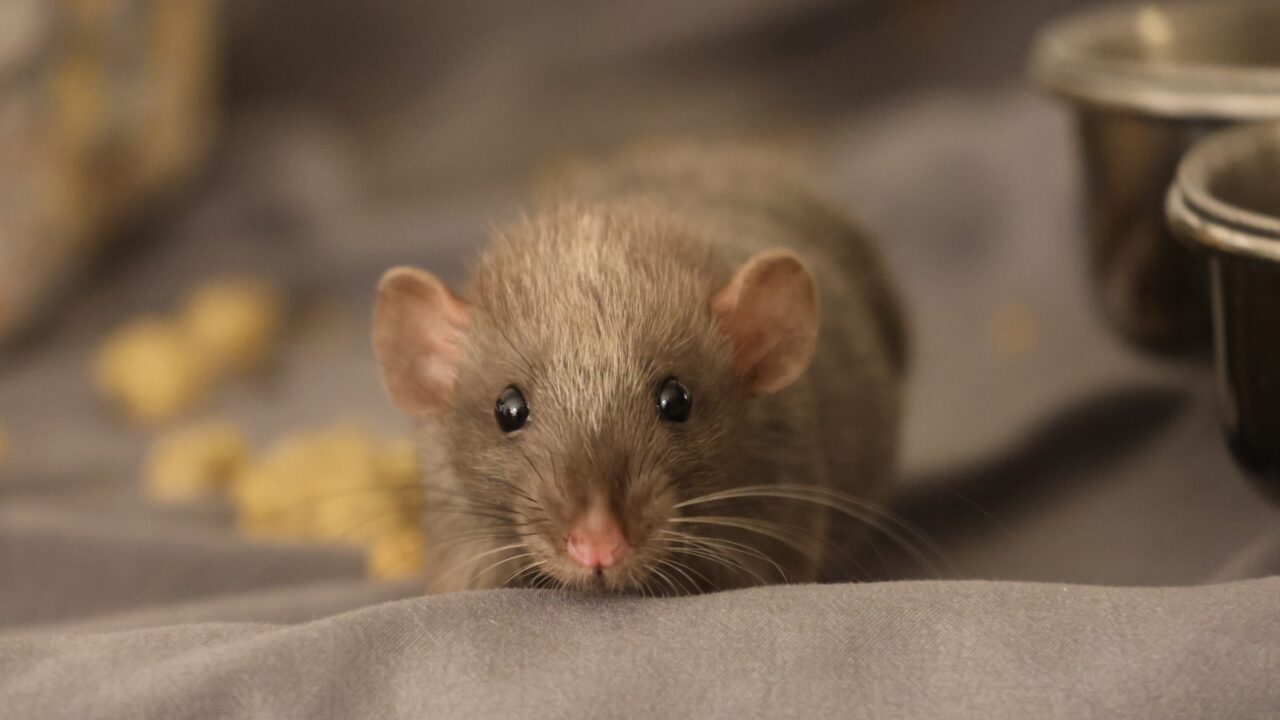
I find it fascinating that we have something like a GPS in the brain, and that some people seem to have more of it working for them than others. The first piece of that system turned up in a rat. Working at University College London, John O'Keefe recorded from single cells in the hippocampus, a curved structure deep in the temporal lobes, and found that certain cells fired whenever the animal was at one particular place in a room, while other cells fired at other places.
He concluded that together they formed a map of the room.
Nobody has counted the place cells in ordinary people to see who has more of them.
How he got there was an accident, which he recounts in his Nobel lecture. In the late 1960s he was recording from cells in the thalamus, studying touch and body sensation in freely moving rats.
On one occasion he placed his electrodes further to the side than intended, "inadvertently" as he puts it in the lecture, and they landed in the hippocampus, then known mainly as a memory structure because of the work of Brenda Milner, who had studied the amnesic patient Henry Molaison. O'Keefe dropped the sensory work to find out what memories looked like at the level of single cells.
What he got was something else. After months of watching rats while listening to the cells, and then one especially clear one, it dawned on him that the cells "weren't particularly interested in what the animal was doing or why it was doing it but rather they were interested in where it was in the environment at the time".
O'Keefe and his student Jonathan Dostrovsky published the result in Brain Research in 1971, under the title The hippocampus as a spatial map. The report ran to three pages.
The figure in it shows a rectangular platform with curtains on three sides, and one cell fired at two locations and nowhere else. Laura Colgin, in a later review of the field, counts what the paper actually contained: 8 putative neurons that fired at particular locations in the test environment.
The paper itself drew the conclusion in a single line: "These findings suggest that the hippocampus provides the rest of the brain with a spatial reference map."
The fuller evidence came later, in a more thorough 1976 study by O'Keefe and in the 1978 book The Hippocampus as a Cognitive Map, written with Lynn Nadel. The phrase cognitive map came from Edward Tolman, who studied rats learning mazes.
On 6 October 2014 the Nobel Prize in Physiology or Medicine went one half to O'Keefe and the other half jointly to May-Britt Moser and Edvard Moser, "for their discoveries of cells that constitute a positioning system in the brain".
The Mosers had found grid cells in 2005 in the entorhinal cortex, a nearby region. These fire at multiple locations arranged in a hexagonal pattern, and the Nobel committee says they "generate a coordinate system and allow for precise positioning and pathfinding". The committee called the whole thing an "inner GPS".
Nadel, Regents Professor Emeritus of Psychology and Cognitive Science at the University of Arizona, said in an email that the older lesion work pointed the same way. "When we saw how well the idea fit the extant data from lesion studies we knew we were on to something."
He thinks the general framework held, that the hippocampus is central to forming cognitive maps. What held up less well, he said, were many of the specific details, and the idea that a cognitive map is like a memory of a particular event. A map, in his account, is a distillation of many separate episodes.
"We have learned so much more about this system in the past 50 years, but on balance we got the core idea right."
Kate Jeffery, who heads the School of Psychology and Neuroscience at the University of Glasgow, studies the cognitive map directly in her lab. She wrote in an email that place cells can tell an animal which room it is in and where it is in the room.
Whether that amounts to a map, in the sense of knowing how the parts of a space relate to each other, is another matter. "Yes they form a map of sorts, but it isn't like a human map, and exactly how it works is still being investigated".
She also flagged a common mistake: assuming a cell codes for a place just because it fires there. If the cell is responding to the smell of crumbs dropped on the floor, "they are crumb cells! (if that's a thing)". "This error is often made by scientists who are less familiar with the field."
In humans, the Nobel committee said, the evidence for place and grid cells comes from brain imaging and from studies of patients undergoing neurosurgery.
Eleanor Maguire and colleagues scanned 16 licensed London taxi drivers in 2000 and found the rear part of the hippocampus larger than in 50 men who did not drive taxis, with volume correlating with years on the job, the study reported. Everyone scanned was male, and what was measured was the size of a structure rather than the cells in it.
A 2011 follow-up by Woollett and Maguire tracked 79 male trainees and 31 controls through three to four years of learning the Knowledge of London's streets. The groups did not differ beforehand in hippocampal grey matter, the tissue made up mostly of nerve cell bodies.
Afterwards an increase in the rear hippocampus was associated with qualifying, and was absent in the trainees who failed and in the controls, the authors write. Again the measure was volume.
Sea Hero Quest, a mobile game built by scientists at UCL and other universities to help dementia research, was played by more than 2.5 million people. In the main analysis, of 558,143 players in 57 countries, Coutrot and colleagues found navigation ability declining with age everywhere. A country's wealth predicted its average score, and its level of gender inequality predicted the gap between men and women. It measured behaviour in a game, not cells.
On dementia, the Nobel committee noted that the hippocampus and entorhinal cortex are frequently affected early in Alzheimer's disease, and that those patients often lose their way and cannot recognise their surroundings. Knowledge of the positioning system, it suggested, may help explain that.
The founding result was 8 cells in rats on a small curtained platform, and most recordings since have been in rodents.
The differences between people are real enough on the measures we have: navigation scores vary widely by age and by country, and years of driving London's streets go with a larger rear hippocampus.
I think that is a difference in behaviour and in the size of a brain structure, which is some distance from a difference in place cells themselves.
Sources
- J. O'Keefe and J. Dostrovsky, The hippocampus as a spatial map. Preliminary evidence from unit activity in the freely-moving rat, Brain Research, 1971.
- J. O'Keefe, Spatial Cells in the Hippocampal Formation, Nobel Lecture, 2014.
- The Nobel Assembly at Karolinska Institutet, The Nobel Prize in Physiology or Medicine 2014, press release, 6 October 2014.
- L. L. Colgin, Five Decades of Hippocampal Place Cells and EEG Rhythms in Behaving Rats, Journal of Neuroscience, 2020.
- E. A. Maguire and colleagues, Navigation-related structural change in the hippocampi of taxi drivers, PNAS, 2000.
- K. Woollett and E. A. Maguire, Acquiring "the Knowledge" of London's layout drives structural brain changes, Current Biology, 2011.
- A. Coutrot and colleagues, Global Determinants of Navigation Ability, Current Biology, 2018.
- UCL, SeaHero Quest used by scientists to carry out research into dementia, 2019.
- Emails from Lynn Nadel and Kate Jeffery, October 2026.