By

Clive Wearing would beg his wife to visit minutes after she had left. The memory of seeing her had already disappeared. In recorded messages played in a Radiolab interview, he pleaded with Deborah to come back: “I haven't seen you yet and I want to.”
He could still recognize her, embrace her and tell her he loved her. He could also sit at a piano and play, or conduct a choir. What he couldn't reliably do was remember those experiences once they had passed.
It began in March 1985, when a brain infection left the 46-year-old British conductor with devastating amnesia. Much of his earlier life became inaccessible, and new experiences could disappear within seconds. For years afterward, he repeatedly insisted that he had only just woken up.
When a headache became something else
Before he became a neurological case study, Clive was a musician whose work demanded an exceptional command of the past. A conductor, musical scholar and BBC Radio 3 producer, he specialized in early music, particularly the Renaissance composer Orlando Lassus.
In March 1985, when he was 46, he developed a headache and fever. Deborah said he often had headaches because he overworked. The local doctors thought he had a bad flu bug.
Around the fifth day, she recalled, he suddenly couldn't remember her name or their home address.
During those early days, he left home, hailed a taxi and found he couldn't tell the driver where he lived. Police helped identify him and return him home. Back at their gate, he appeared not to recognize the place he had just been brought to.
The diagnosis was herpes simplex viral encephalitis. The virus more commonly associated with cold sores had infected his brain, causing destructive inflammation.
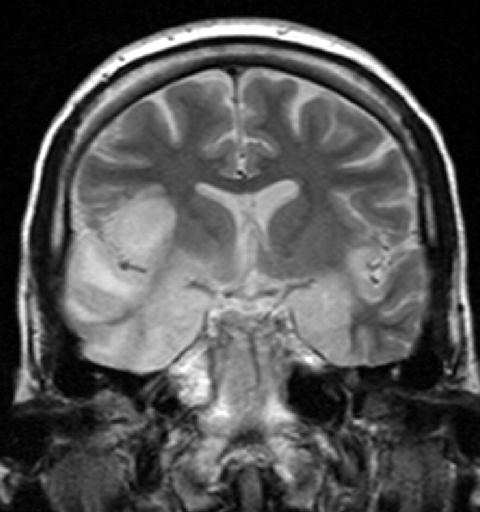
He was given acyclovir, an antiviral drug. The clinical account by Barbara Wilson, Michael Kopelman and Narinder Kapur says it probably saved his life. But large areas of his brain had already been damaged.
This was an infection that could kill. A 1988 study of 24 patients treated in Glasgow between 1972 and 1985 reported that 14 died. Intravenous acyclovir was associated with the best prognosis.
Those figures belong to a small historical group, not to a prognosis for someone diagnosed today. What they establish here is the seriousness of the illness Clive survived. Keeping him alive and preserving his memory were two very different outcomes.
What the virus actually took
Clive's illness didn't just erase much of his past. It also severely damaged his ability to form new memories.
These were two separate problems, and together they explain why his condition was so devastating.
The 1995 report by Wilson, Alan Baddeley and Kapur described severe amnesia affecting memories of events and experiences, known as episodic memory, as well as semantic memory, our store of facts and knowledge.
Clive had profound anterograde amnesia: enormous difficulty retaining new experiences as lasting memories. He also had extensive retrograde amnesia: much of the life he had lived before becoming ill was no longer accessible to him.
His brain scans showed why this was more than an ordinary problem with forgetting. The damage involved structures on both sides of the brain, including the hippocampal formations, alongside other regions. The hippocampus and its surrounding networks help establish memories of events and experiences. It wasn't the only area injured.
Yet there were things he still knew. He knew who he was, that he was a musician and that he was married. There were fragments of his earlier life available to him, even though he could not reconstruct most of it as a sequence of personally remembered experiences.
Knowing you got married isn't the same as remembering your wedding. Clive still knew certain facts about himself, but much of the life behind those facts had become inaccessible.
The seven-second description leaves something out
Clive is often described as the man with a seven-second memory. But that description can be misleading. He didn't lose consciousness every seven seconds, and he could sometimes hold information in mind for longer than that.
In the 2008 follow-up, his immediate memory span was normal on particular tests. He could repeat seven digits and reproduce a sequence of five blocks. The devastating impairment appeared when he was asked to recall information after a delay.
That doesn't mean everyday conversation was easy for him. It means the ability to hold something briefly in the present and the ability to retain it for later could come apart.
His repeated declarations that he had just woken up were another part of the puzzle. The researchers considered whether this was a fixed false belief, a disruption of autobiographical awareness, or a way of explaining a world for which he had almost no remembered evidence.
They did not settle the question by saying he literally lost consciousness every few seconds. He had been awake, writing, playing and responding to people. What he could not reliably retain was the experience of having been there.
The musician who could still make music
Then there was the piano.
Clive could sit down and play, read notation and conduct musicians. Abilities built over years of training remained available even when he could not remember what had happened minutes earlier.
Our brains don't store every kind of memory in the same way. Remembering what you ate yesterday and knowing how to play the piano rely on partly different systems. Clive had lost much of his ability to remember experiences, but the musical skills he had spent years developing remained remarkably intact.
Clive wasn't simply repeating movements his fingers had memorized. He could still read music, improvise and respond to other musicians, abilities that required more than recalling a familiar tune.
The researchers couldn't establish whether Clive was capable of learning new pieces of music. He had been an exceptionally skilled sight-reader before his illness, and he retained that ability afterward. Watching him perform therefore couldn't tell them whether he had remembered a piece or was simply reading it as he played.
So his playing wasn't necessarily an old tune being retrieved intact from somewhere the virus hadn't reached. It could involve reading what was in front of him and making music in the present.
Deborah was familiar when almost nothing else was
But the most moving footage of Clive has nothing to do with his music. It's the moment Deborah walks into the room.
In The Man With the Seven Second Memory, he embraces and kisses her with extraordinary intensity. Knowing that he could not retain her visits makes those reunions difficult to watch without trying to imagine what she represented to him.
Watching them, I found myself thinking about my own husband, Matias. What if something like this happened to him? Would our marriage survive? I tried to imagine our life with the conversations, plans and ordinary shared memories suddenly beyond his reach, while I could still remember everything we had built together.
Deborah had faced that question in real life. After years of campaigning for appropriate care, and once Clive was settled in a specialist facility, she moved to America to try to start again. Their separation also involved divorce. In an archival interview with 60 Minutes Australia (around 12:42), she described being in acute emotional pain and needing to get as far away as possible. “I had to. I couldn't endure it. It was too painful,” she said.
She eventually returned to England. The publisher's account of her memoir, Forever Today, describes how she found she could not love someone else as she loved Clive. They renewed their marriage vows in 2002. Asked in the television interview what had brought her back, her answer was simply: “Clive.”
That part of their story is very close to my heart. I love my husband so deeply that, from where I stand now, even brief moments of feeling connected to him seem more precious than the thought of a life with anyone else, or without him. I can't know what years of that loss would ask of me. But when I watch Clive and Deborah together, I can understand the pull of those moments and why she wanted to return.
Clive frequently couldn't explain where he was, how he had arrived there or what had just happened. Then someone familiar appeared. In his Radiolab interview, neurologist Oliver Sacks described the reaction as relief and excitement.
Clive didn't always recognize Deborah. Oliver Sacks noted that he could sometimes forget her name or fail to recognize her in passing. He struggled to describe her, too. But when they were together, the affection between them was unmistakable, even though he couldn't reliably remember their shared life.
Clive's story doesn't prove that love is somehow immune to memory loss. But it shows that a person can lose the memories of a relationship without necessarily losing the emotional connection to someone they love.
Deborah used a striking image to explain why he couldn't safely go out alone: “It would be like if you were spacewalking and the rope broke.” He would have no reliable way to find his way back.
Then she would go home, and he could lose the memory of the visit. Archival recordings preserved his repeated calls asking her to return, sometimes shortly after she had left.
Learning without a memory of learning
Despite his severe amnesia, Clive gradually became familiar with the place where he lived. In his 2007 account of meeting Clive, Oliver Sacks described how he could find the bathroom, dining room and kitchen, but could lose his way if he stopped to think about where he was going.
The researchers also found residual learning in more structured tasks. Clive did better when a teaching method prevented errors than when it allowed him to make mistakes. They interpreted the advantage as evidence of implicit memory: information influencing performance without being available as a consciously remembered experience.
He could find a familiar kitchen without remembering what he'd eaten there the previous day. And although he performed better in some learning experiments, he still couldn't independently organize his daily life.
The man who repeatedly felt he had just become conscious was not entirely cut off from learning.
What changed over twenty years
The long follow-up didn't reveal a dramatic recovery. In their 2008 paper, Wilson, Kopelman and Kapur reported that Clive's memory functioning on conventional neuropsychological tests had remained largely unchanged over 21 years.
But alongside those results, they recorded Deborah's observations of changes in everyday memory and conversation. He seemed able to hold information for longer than before and follow film plots more easily. The authors also noted changes in his emotional disposition and insight that they wanted to investigate further.
The formal tests still showed profound memory impairment. Deborah, meanwhile, had noticed changes in his everyday behavior that weren't fully reflected in those results. The researchers could document those differences without concluding that his memory had recovered.
The early accounts could be agonizing: crying, anger, confusion and occasional aggression. Later footage showed a man who could still be profoundly disoriented, but could also joke, make music and sit peacefully with the people around him.
I also tried to find out what the published papers and documentaries might have left out. I contacted several people who had been directly involved in studying Clive over the years, as well as Deborah herself.
A few replied, but with a similar reservation: they did not feel comfortable sharing more about Clive without his or Deborah's consent. Deborah did not respond to my messages.
In a story built around a man who became extraordinarily famous for something intensely private (the workings of his own damaged memory), that reluctance felt significant in itself. Clive and Deborah have already allowed researchers, filmmakers and millions of strangers unusually far into their lives. Decades later, some of the people who knew his case best still seem careful about where that access should end.
So there may be parts of Clive's later life that remain outside the scientific papers and the camera frame. Perhaps that is where they belong.
Clive never regained the memory abilities he had before the infection. But over the years, he developed habits, became familiar with places and continued to respond to the people around him.
Near the end of the documentary (around 46:45), he is asked what he would like to do next. His first answer is wonderfully ordinary: “A gin and tonic, I think.” Then he talks about waiting for time to disappear and for Deborah to arrive.
After everything Clive had lost, I found something comforting in such an ordinary answer. He wanted a drink. And he wanted Deborah to come back.
Clive Wearing became famous as the man whose memory lasted only seconds. His case reveals something considerably stranger: a person can lose much of the ability to remember his life as it unfolds without losing every part of the person who is living it.
Sources and further reading
- Wilson, Baddeley and Kapur (1995), clinical report on Clive Wearing. https://pubmed.ncbi.nlm.nih.gov/8557808/
- Wilson, Kopelman and Kapur (2008), twenty-one-year follow-up. https://doi.org/10.1080/09602010802141889
- Oliver Sacks (2007), The Abyss. https://www.newyorker.com/magazine/2007/09/24/the-abyss
- Radiolab, Clive, with archival recordings and an interview with Oliver Sacks. https://radiolab.org/podcast/91578-clive/transcript
- The Man With the Seven Second Memory, documentary. Gin-and-tonic remark: approximately 46:45. https://www.youtube.com/watch?v=k_P7Y0-wgos&t=2805s
- 60 Minutes Australia, interview with Deborah Wearing. “I couldn't endure it”: 12:42. https://www.rev.com/transcripts/meet-the-man-with-a-30-second-memory-transcript
- Deborah Wearing, Forever Today, publisher's page. https://www.penguin.co.uk/books/327251/forever-today-by-deborah-wearing/9780552771696
- Original reporting outreach to researchers and Deborah Wearing (correspondence retained by the author).