By
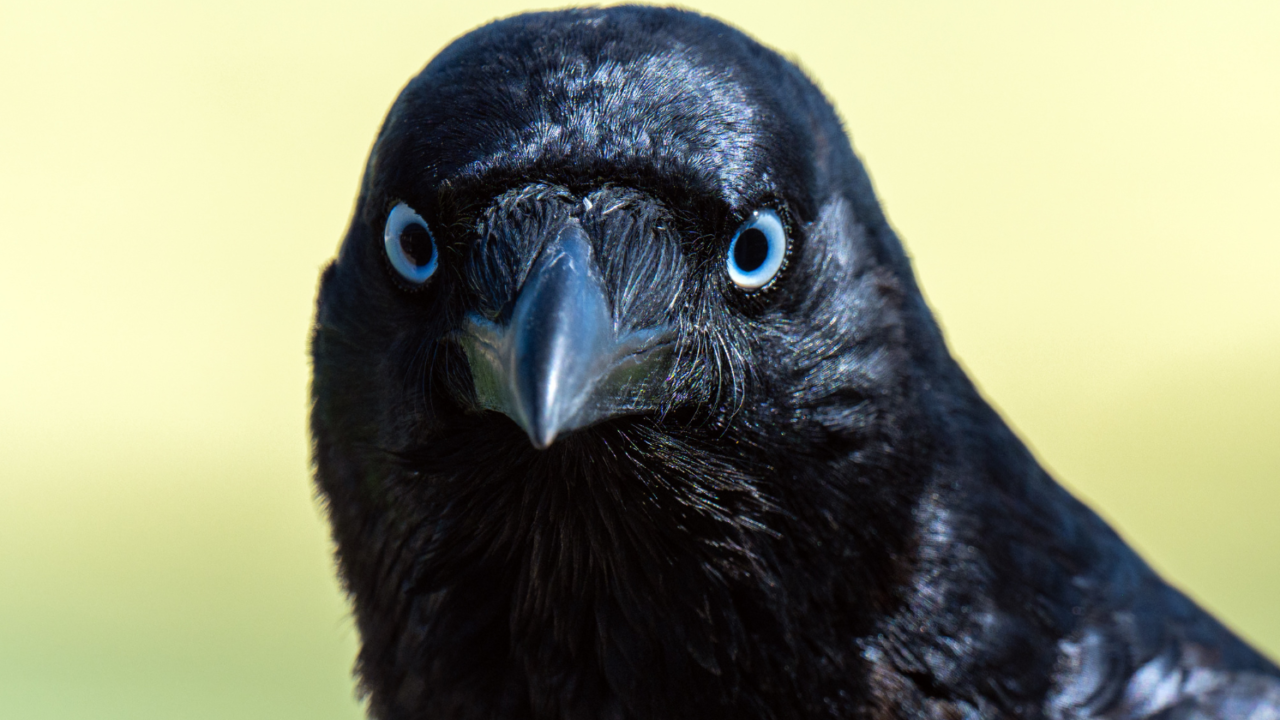
In a laboratory at the University of Tübingen in Germany, a crow named Iggy watches a screen covered in flickering dots. Most of the dots drift randomly, but some move together in one direction. Iggy’s task is to work out which way they’re heading and peck the right answer.
He does it in less than a quarter of a second. A new study suggests that’s about twice as fast as humans or monkeys manage on similar tests, and recordings from his brain showed the decision forming before he moved at all.
A classic test of perception
The task is a well-known one in neuroscience. Scientists have used moving-dot tests with monkeys and humans for more than 20 years to study how the brain turns what we see into a decision.
The difficulty can be adjusted by changing how many dots move together. When most dots move the same way, the answer is easy. When only a few do, the brain has to gather evidence for longer before deciding.
Iggy and Lemmy
Neurobiologists Philipp Schmidbauer and Andreas Nieder trained two carrion crows, Iggy and Lemmy, to do the test. The birds were given up to three seconds to answer, but they needed far less.
On average, they pecked their answer in about 235 milliseconds, just under a quarter of a second. They stayed highly accurate too, so they weren’t simply guessing to be quick. Like humans and monkeys, they also took slightly longer on harder trials and on the ones they got wrong, a sign of a genuine, deliberate decision.
How they compare with us
The study didn’t test crows, monkeys and humans side by side. Instead, the researchers compared their results with earlier studies using similar self-paced tests.
In those studies, monkeys took roughly 410 to 600 milliseconds to decide, and humans took about 450 to 820 milliseconds. That’s why the crows are described as roughly twice as fast. It’s a striking result, though it comes from only two birds and a single type of task.
Watching a decision form
While the crows worked, the researchers recorded the activity of 248 individual brain cells in a region called the nidopallium caudolaterale. This part of the bird brain plays a similar role to the prefrontal cortex in humans, the area involved in planning and decision-making.
About a quarter of the cells responded more strongly to one direction of movement than the other. Just 70 milliseconds after the dots appeared, their activity was already pointing towards the answer the crow would choose. As the bird took in more information, the activity climbed until it reached a threshold, and then the crow pecked.
Different brains, the same method
This rising pattern closely matches what scientists have seen in monkeys, where brain cells build up evidence until a decision is reached. That’s remarkable, because bird and mammal brains are built very differently. Birds don’t have the layered cortex that primates use for complex thinking.
Instead, crows pack huge numbers of neurons into a small brain. A crow’s decision-making region contains nearly as many neurons as the equivalent area in a rhesus monkey, squeezed into a much smaller space. Shorter distances between cells may help signals travel faster, though the researchers say more work is needed to explain the speed.
Why speed might matter to a crow
Crows live fast-paced lives. They need to react quickly when flying, avoiding predators, catching prey or snatching food before another bird gets to it. Quick visual decisions could be a real advantage in the wild.
The research also adds to a growing picture of crows as unusually intelligent animals. They can use tools, recognise individual human faces and solve complex puzzles. The new study suggests that, at least for some decisions, a bird’s brain may not just match ours but beat it for speed. “Birdbrain” may be one of the least fitting insults in the English language.