By
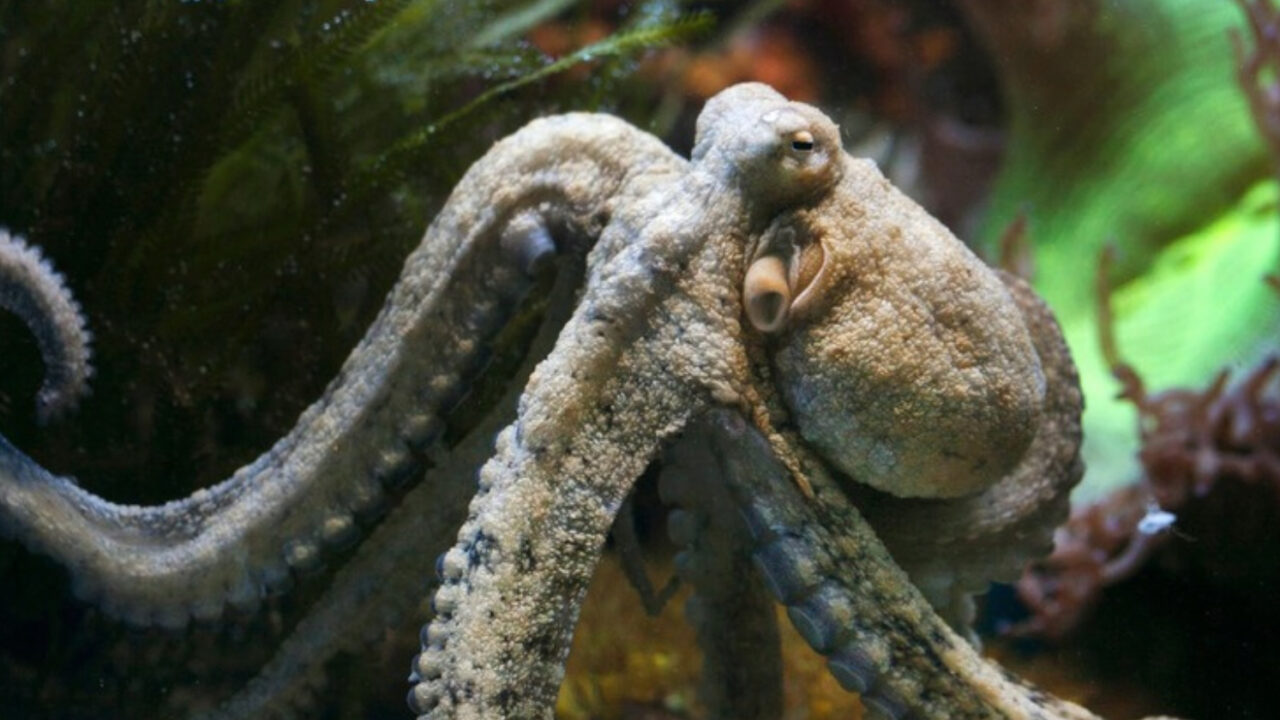
The first time the octopus saw the crab, it did what an octopus does with prey. It swam straight at it.
The trouble was that the crab it could see was a reflection. The real one was in a jar behind a corner, out of sight, and the octopus paid it no attention at all.
That was the first trial of a 2026 study from Dartmouth College, and it happened to all three animals. What came next is the interesting part.
A mirror is a hard thing to understand
A mirror is a strange object if you have never met one. It shows you a world that looks solid and reachable, but is actually somewhere else entirely.
Most animals treat the reflection as the real thing. Many attack it, court it or simply ignore it. Understanding that an image points to a place behind you takes a surprising amount of mental work.
Plenty of animals have been tested on a related puzzle: do they realise the reflection is them? Magpies and cleaner wrasse have both reacted to a coloured mark that was visible only in a mirror, as if they wanted it off their own bodies. Both results are still argued over, and the fish researchers themselves are cautious about what theirs means.
The Dartmouth team asked something different. Could an animal use a mirror as a tool, to work out where something is?
Three octopuses, one crab in a jar
The researchers worked with three wild-caught California two-spot octopuses. Each one first got used to a mirror in its tank. Then came the test. A live crab sat in a glass jar that the octopus could see only in the mirror, and reaching it meant making a 90-degree turn around a corner.
On that first trial, all three went for the reflection. They showed no reaction to the real crab when it came into view. Only after reaching the mirror did they turn to the jar and take the crab.
It took each animal 10 to 12 trials to stop. After that, they went directly to the real crab and ignored the one in the glass.
Learning to hold back
This is where the claim in the headline comes from. A trained octopus really does skip the reflection and go looking for the real thing. But it had to learn to.
The authors describe this as learned inhibition. The urge to pounce on prey you can see is strong. These animals overrode it, which suggests their hunting behaviour is not a simple reflex. Some part of the brain can say "not that one".
Peter Tse, the study's senior author, likens octopuses to cats. They sneak up on prey and pounce, and they want to do it fast, before anything bigger spots them. A hunter like that does better with a mental map of its territory, and he thinks octopuses may have one. The team has not shown it yet.
Octopuses are known for being clever with their arms and suckers, and they taste what they touch. Yet in the main test they had only their eyes to go on, because the virtual crab could not be smelled or touched.
The virtual crab
The harder test came next. The team projected a virtual crab onto a screen behind the animal, on either the left or the right. A mirror reflected it, but walls around the start box blocked any direct view.
To earn a real crab, the octopus had to turn away from the mirror and go to the side where the projection was. The three animals picked the correct side about 73% of the time. Chance would be 50%.
Some did not even bother with the exit. They climbed over the wall of the box to reach the right spot.
"We don't enter the world knowing how to use a mirror but learn how to use a mirror," said Tse. He compared it to learning to use a car's rear-view mirror.
What this does and doesn't show
Three animals is a very small group. Their accuracy was good, not perfect, and they did not always take the shortest route. Other groups will need to repeat the work before anyone can say how typical this is for octopuses.
It also does not show that octopuses recognise themselves. Nobody tested that here. The authors suggest the animals might hold some kind of internal map of space, but they say more research is needed to prove it.
Kieseler describes it as the first demonstration that an invertebrate can use a mirror to find prey. It is a skill that had only been documented in some mammals and birds before. What the study does show is that an animal separated from us by hundreds of millions of years of evolution can learn to read a mirror. The crab in the glass was a trick, and it took ten trials or so for each octopus to see through it.