By
The smell of Parkinson's has held up under testing. The chemicals first blamed for it have not.
On 19 April 2012, Joy Milne went to a Parkinson's UK event at the University of Edinburgh, hosted by the stem cell biologist Tilo Kunath. When the talk ended, she stood up and asked why nobody used smell to diagnose the disease. By her own account, she then told the room she could smell Parkinson's all around her.
Milne was a retired nurse. Her husband, Les, a doctor, had Parkinson's, and years before his diagnosis, she says, his smell had changed: heavier, oilier, musky. She blamed the shower. Only later, at a Parkinson's UK meeting, did she catch the same odor on strangers.
Kunath's first reaction was to wave it away. "It just didn't seem possible," he told NPR in 2020. Then he heard that dogs can smell cancer, and he thought again. If she was wrong, a simple test would show it.
Twelve shirts
Twelve people wore T-shirts overnight, six with Parkinson's and six without. The shirts were bagged away from the wearers, and Milne sniffed each one without knowing which was which.
She identified all six of the patients' shirts. She also picked out one control shirt and insisted that wearer had Parkinson's too. On the scientists' key, that was a miss: 11 out of 12. Then the man got in touch. Kunath told ABC News in 2015 that "eight months later he informed me" he had been diagnosed. The score became 12 out of 12.
The 12 counts shirts, not people, and the delay is not settled: Edinburgh's account says eight months, Milne's own university profile says nine, and Chemistry World reported three.
The irony in the nose
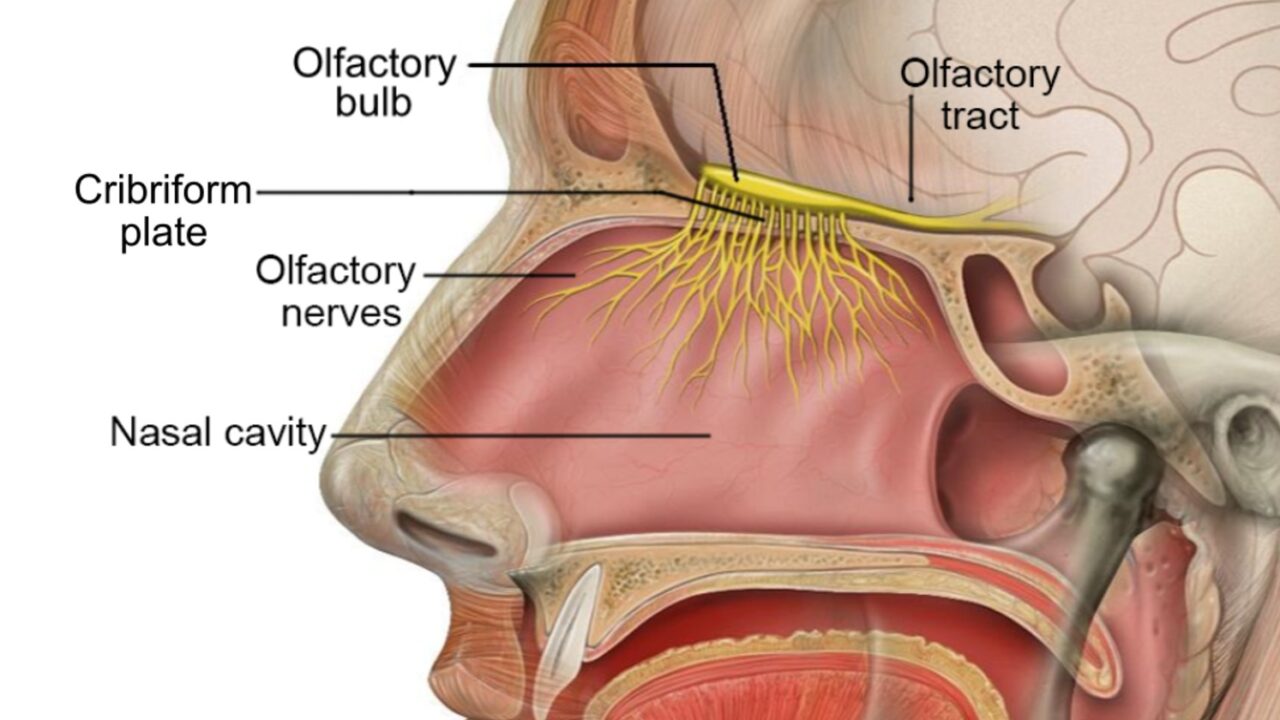
Her gift comes with an irony. Parkinson's often takes away the patient's own sense of smell, frequently years before the tremor, and by some estimates up to 90 percent of patients are affected.
In 2003, the German anatomist Heiko Braak and colleagues proposed that the disease does not start in the brain's movement areas. The first damage appears in the anterior olfactory nucleus, part of the smell system, and a brainstem nucleus tied to the vagus nerve. From there it climbs over years, as a misfolded protein called alpha-synuclein gathers into clumps. Braak's staging is debated, but it helps explain why smell loss so often arrives first.
Why the neck mattered
Milne told the team the smell was strongest on the neck and upper back, a clue no armpit swab would have found. Those areas are rich in sebum, the oily film the skin makes. The 2019 paper reports that preliminary tests found the odor in high-sebum areas, not in the armpits.
Monty Silverdale, a neurologist at the University of Manchester, says this fits what doctors see: seborrhoea, an oily skin condition, is "very common" in people with Parkinson's.
From nose to machine
Milne could not be the test. She saturates after five to ten samples and has to change her shirt several times a day to clear the build-up of smells. So Perdita Barran's lab at Manchester took the odor apart with a mass spectrometer, and Milne sniffed the separated compounds as they came off the machine.
In 2019, the team reported a distinct volatile signature in sebum from 64 people, then checked it in a second group of 31. Only two compounds were significant in both groups: perillic aldehyde was lower in Parkinson's, eicosane was higher. In 2022 came a three-minute skin-swab method, tried on 150 people, with a press-quoted 95 percent accuracy that does not appear in the paper.
The molecules that did not hold
In 2021, a Manchester replication tested 100 people with Parkinson's and 29 without, and classified them correctly 84.4 percent of the time. The signal was real. The named chemicals were not. Purified standards of eicosane and octadecanal did not match the patient samples, and the authors wrote that the 2019 compounds "could not be validated."
An outside team came at it differently. In 2024, researchers in Dresden led by the smell scientist Thomas Hummel had a panel of 26 young women sniff shirts worn by 19 people with Parkinson's and 15 without. The panel perceived a distinct Parkinson's odor, and about 80 percent could tell the real thing from an artificial mix of four compounds the earlier work had named.
So the odor exists, and the four chemicals do not account for it. Dresden was not a repeat of Milne's test, since it never asked whether a second smeller could diagnose people.
What other noses found
Machines have taken a turn too. A 2024 study in China used an electronic nose on 121 people with Parkinson's and 129 without, reaching about 83 percent sensitivity (how often a test catches people who have the disease) and 84 percent specificity (how often it clears those who do not).
Dogs did similar or better. A US group reported 89 percent sensitivity and 87 percent specificity in household pet dogs, and a Chinese study of sniffer dogs found 91 and 95 percent in patients on medication.
The most striking result is also the smallest. A 2025 Manchester study had a tester with hyperosmia sort samples from nine people with isolated REM sleep behavior disorder, which often comes before Parkinson's. Three were classified as Parkinson's, and two of those later showed symptoms on clinical follow-up. It is an intriguing hint at early detection, resting on nine people.
What a swab could be worth
Silverdale told Neuroscientifically Challenged that a reliable swab "could be extremely useful," first for sorting referrals, with "around 15,000 patients waiting for a neurology appointment" in Manchester. The larger prize is earlier diagnosis: "It is possible that we are simply starting these treatments too late, after substantial damage has already occurred."
The bar is lower than it sounds. A 2016 review found clinical diagnosis of Parkinson's was right about 81 percent of the time, and about 74 percent when made by non-specialists. Two lab tests that look for alpha-synuclein itself, a skin biopsy test and a spinal-fluid test, report higher figures: the biopsy found it in 92.7 percent of people with Parkinson's and 3.3 percent of controls. Both were measured against clinical diagnosis, so the comparison is not like for like. A swab would still be easier than either, if the chemistry is ever pinned down.
What the smell can and can't prove
Milne's origin story is real and the 12 out of 12 stands.
The researchers describe Milne as having hereditary hyperosmia, an unusually keen sense of smell, but that rests on her own account, and the literature search for this piece found no published test of it.
How a sample is collected changes results a lot: in one conference abstract, a swab and a skin patch matched on only 35 percent of compounds. Milne and Barran are co-authors on most of the positive studies, and so is Silverdale, who is quoted in this piece.
There is also no approved test and no preventive treatment. Silverdale says anyone who tested positive today would have to be told "that we do not yet have a proven treatment to prevent Parkinson's disease." A University of Manchester spinout company, Sebomix Ltd, was set up to develop the swab.
Will she be believed?
Fourteen years on, the smell has survived and its explanation has not. Dresden's panel, an electronic nose and several groups of dogs all point to something real on the skin.
A short drama inspired by her story, A Scent, starring Josie Walker as a Scottish nurse whose husband and lead surgeon dismiss her, is being prepared for a festival run, the BBC reported in April. In the film, the question is whether she will be believed. In the lab, the question is now what she was smelling.