By
I'm one of three sisters, and my parents mix up our names all the time. As a child, I found it hard to understand. They knew exactly who I was. They had picked the names themselves. How hard could it be?
Later I noticed a pattern. Sometimes they call me by the name of whichever sister is on their mind at the time. A few months ago, my parents visited my sister in Paris, and for a while after they came back, they kept calling me by her name. The same goes for whichever of us is causing the most trouble at the moment, or is somehow the centre of attention. Other times, they go through all three names, one by one, until they get to mine. That version is my favourite. It's like watching someone try every key on the ring.
So I was delighted to find that a 2016 study from Duke University opens with exactly this scene: a mother calling "Becky . . . Jesse . . . Molly . . . no, Samantha!" Across five surveys with more than 1,700 people, researchers led by Samantha Deffler, then a PhD student at Duke, found that the wrong name usually comes from the same group in our heads as the right one. Family gets mixed up with family, friends with friends. The family dog is in the family group. The cat, much less so.
The wrong name comes from the right group
The first survey asked 1,519 Duke undergraduates a simple question: had someone familiar ever called them by the wrong name? 51.0% said yes, and 95.0% of them said it was a family member who did it.
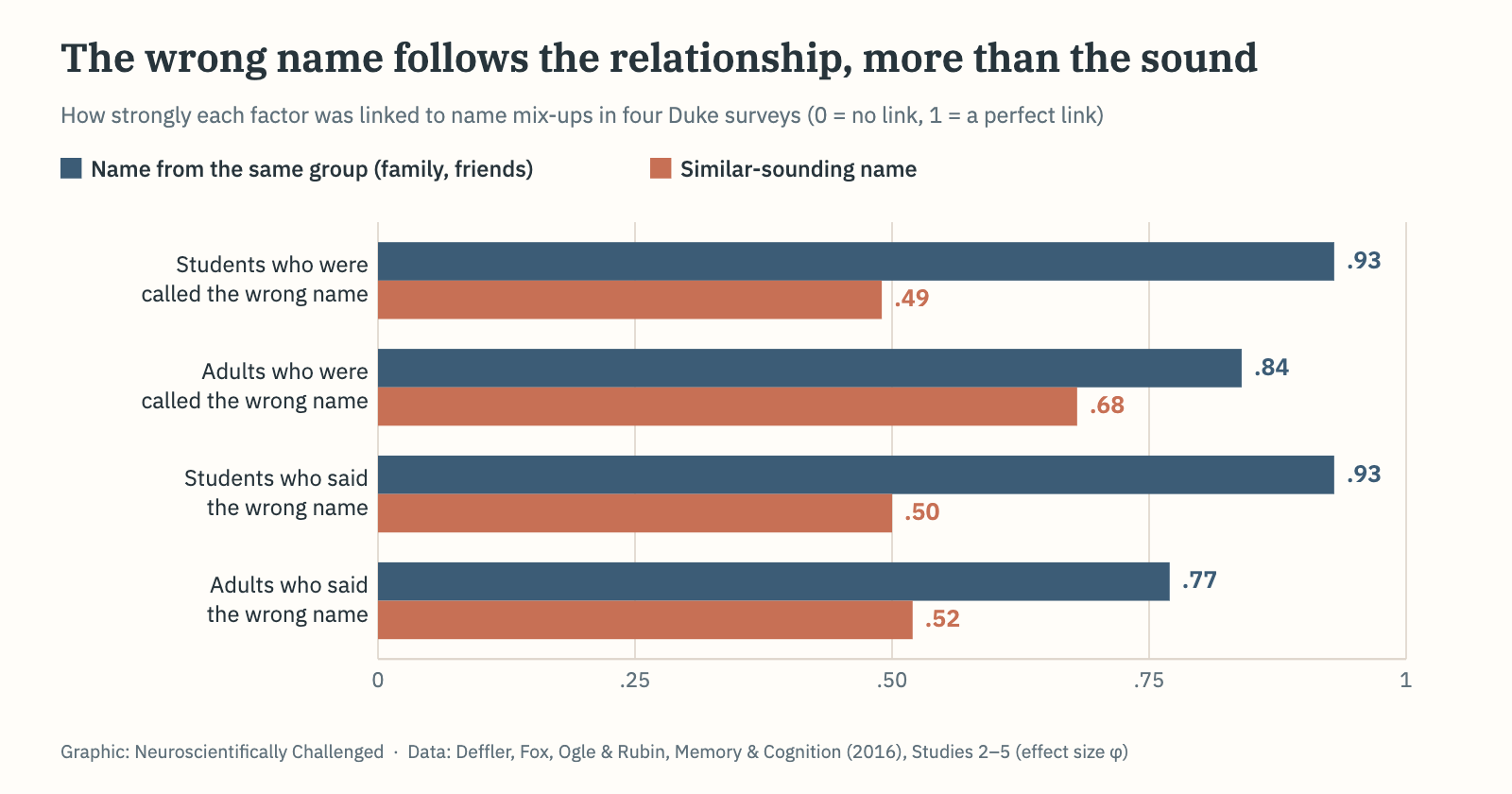
The other four surveys went deeper, with Duke students and with adults recruited online. Some asked the people who were called the wrong name, others the people who said it. When the team compared the names, the strongest pattern was the relationship. A child got a sibling's name. A friend got another friend's name. "It's a cognitive mistake we make, which reveals something about who we consider to be in our group," senior author David Rubin told Duke Today. "It's not just random."
Sound mattered too, just less. Names that start or end the same way, like Michael and Mitchell, or share a vowel sound, like John and Bob, were more likely to be swapped, the Duke write-up says.
Looks barely mattered: parents swapped their children's names even when the kids looked nothing alike and weren't the same gender.
So my parents weren't grabbing names at random. They were reaching for the right shelf and taking the wrong name off it.
Why the wrong name comes out so easily
When I asked Ingrid Olson, a neuroscientist at Temple University who studies how we remember people, why a parent's wrong name so often belongs to another family member, she opened with a question: "Do you know the concept of a semantic network?" I do. It's one of the ideas in psychology I first learned with real fascination, and it still impresses me.
The idea has been around for half a century. In a 1975 paper, psychologists Allan Collins and Elizabeth Loftus described our store of meanings and facts, part of what neuroscientists call explicit memory, as a web. Every concept is a knot, and related concepts are tied together. The more two things have in common, the more threads run between them. Think of one knot, and activation spreads along the threads to its neighbours, getting weaker as it goes, "like a signal from a source that is attenuated as it travels outward," as they put it. It's also why one word can bring a related one to mind faster, an effect called priming.
Olson's example was, fittingly, a dog. The concept "dog," she told me, "is closely linked to 'cat'," and also to words "like leash, bark, and bone," while ideas like "safety" sit further away.
Names, she thinks, work the same way. They "are probably organized in networks based on several different groupings, including social relationships." Then she gave an example from her own family that could almost have been about mine. Her mother, she said, "who has 3 daughters as well as 3 sisters, has separate, but closely related 'webs' for these groupings." So Olson's name is easier to confuse with her sister's than with one of her aunts', "due to proximity in the network."
She added one more reason names in particular slip: "Proper names are very difficult to remember ... in part because they are arbitrary." Nothing about a name tells you whose it is.
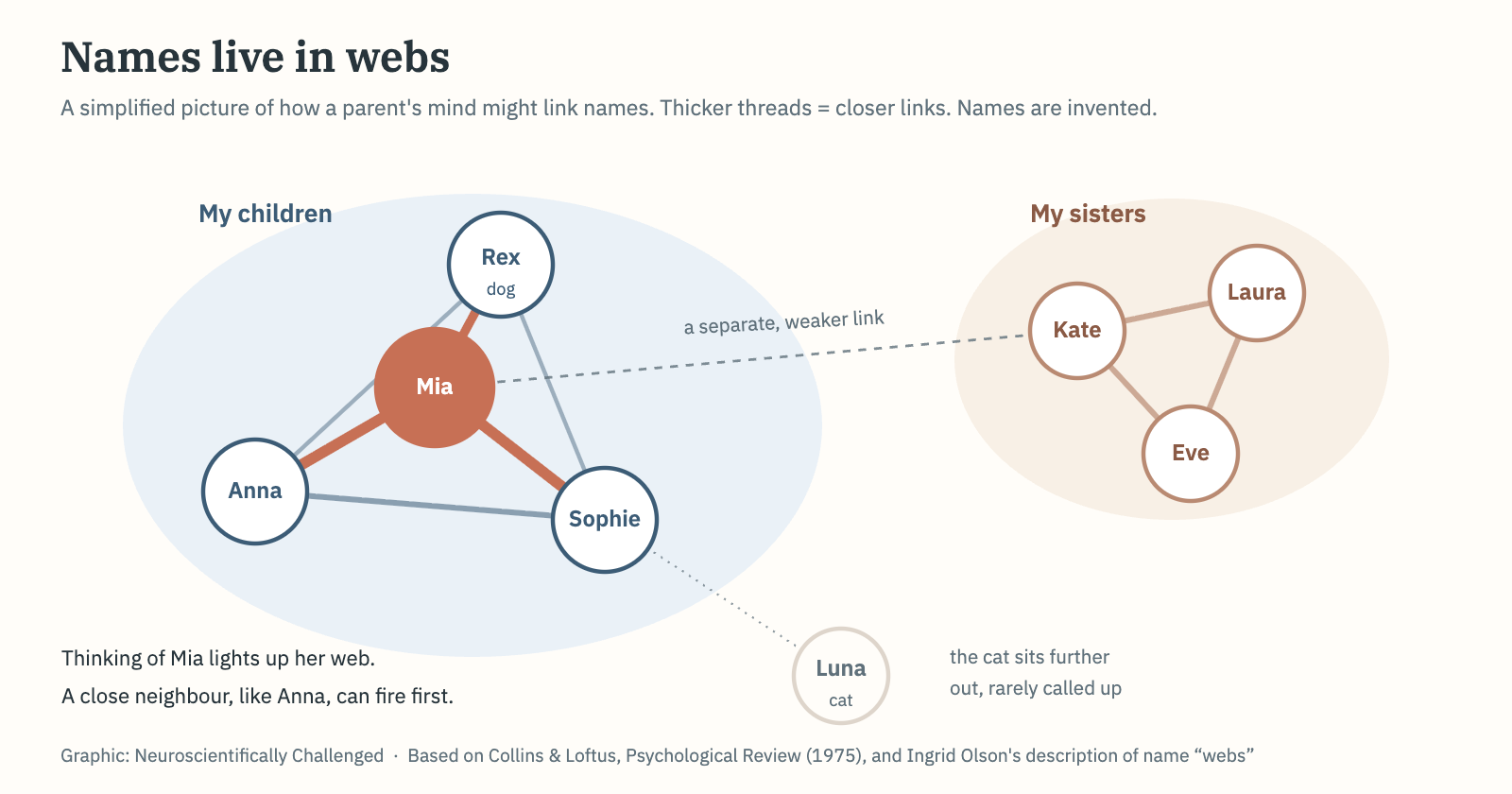
Two more details from that 1975 paper fit my family almost too well. A thread gets stronger the more often it's used, and the names themselves sit in a second web, organized by how they sound. So whichever sister my parents have been thinking about most, the one they've just visited or the one keeping them busy, already has her knot lit up, and names that sound alike get a shortcut of their own, just as the Duke surveys found.
All of this explains why the slip is so smooth, too. A misnaming isn't like having a name on the tip of your tongue, where you search and nothing comes. In the Duke paper's words, it's "the fluid replacement of the misnamed's correct name with an incorrect (but often plausible) name." The wrong name just arrives, ready to go.
The researchers weren't above it either. They admit it in the paper's first paragraph:
"The last author, having experienced this seeming insult by loving parents as a child, now does it to his graduate students, and he only has two." (Deffler, Fox, Ogle and Rubin, Memory & Cognition, 2016)
Where would those webs live in the brain? The Duke study didn't look, since it was a set of surveys. But brain research on how we know people keeps pointing to the front part of the temporal lobe, called the anterior temporal lobe. A review led by Olson proposes that this area plays a key role in storing what we know about people, "their names and biographies" included. It also describes a split: the left side is more tied to retrieving names, the right side to the feeling that someone is familiar and to what we know about them.
And then there's the dog
Across the four detailed surveys, 42 misnamings involved a pet's name. In all but one, the person meant to say a family member's name. Parents called their children by a pet's name 18 times, and siblings did it to each other 16 times.
Nearly all of those pets were dogs. Cats, the authors write, "were owned by our participants about as often as dogs," yet "they were rarely included in a string of incorrect names (of all of the naming strings that contained a pet's name, only four nondog names were used)." Their reading: "dogs are grouped with other (human) family members, much more so than other pets."
Deffler's explanation is a practical one. "I'll preface this by saying I have cats and I love them," she told Duke Today. But "dogs will respond to their names much more than cats, so those names are used more often. Perhaps because of that, the dog's name seems to become more integrated with people's conceptions of their families."
That sounded very familiar. The name my parents grab first belongs to whichever of us they've been thinking and talking about most lately. Deffler's dog works in a similar way: the name you say all day is the one that's ready.
A 2013 survey by psycholinguist Zenzi Griffin and Thomas Wangerman had found the same thing three years earlier. Of the 334 people they asked, 20 said a parent had called them by a pet's name, "primarily dogs, a few cats, and one horse." They also found that parents swap their children's names more often when the names sound alike. Their take on the pets is a little different: pets' names are used to call the animal over, and the way we call pets and children can overlap.
I asked Griffin about that sound-alike finding: should parents choosing a name for a second or third child keep it in mind? "In my opinion there is not a single answer," she told me. "There are pros and cons of giving your children similar sounding names." On one side, "there is the increased risk of misnaming." On the other, "having similar sounding names can increase the sense of being one distinct family, especially when parents might not share a last name." In some cultures, she added, that's the tradition: in China, "the first character of a given name is traditionally taken from a family poem and shared by all male members of a generation."
Duke's own press release went further than the paper. It said owners of cats or other pets "didn't commit such slips of the tongue." The paper says four non-dog names did turn up, and it never counts cats on their own. So "rarely" is the accurate word, and it's the one I kept.
Still, keep in mind what kind of study this is. Everything comes from people remembering past mix-ups, and we tend to remember the funny or awkward ones. The 51% comes from college students, which is common in academic research, and the online adults in the later surveys took part because it had happened to them, so they can't tell us how common it is. The dog finding rests on 42 episodes out of 904, about 4.6%. And I couldn't find anyone who has repeated the dog-and-cat result, or run the diary study the authors suggest, where people write down each slip as it happens.
So if someone calls you by your brother's name, or the dog's, take it as a compliment. It means you're in the web. The cat, apparently, will have to try harder.