By
1,230 grams. That's roughly the weight of a bag of sugar and a bit, and it's what the most famous brain of the 20th century weighed on a hospital scale in April 1955.
It was less than the brain of an average adult man, which is usually closer to 1,400 grams. That was the first surprise. The rest of the story turned out to be much stranger.
A pathologist on the early shift
Albert Einstein died at Princeton Hospital in New Jersey in the early hours of 18 April 1955. He was 76. He had asked to be cremated, and he didn't want his body turned into an object of worship.
The pathologist on duty that morning was Thomas Harvey. During the autopsy he removed Einstein's brain, weighed it, photographed it from every angle and kept it. Einstein's son, Hans Albert, gave his blessing afterwards, on the condition that any research would be done for science.
Harvey then had the brain dissected into 240 small blocks, each about the size of a sugar cube. They were sealed in a hard, rubbery material called celloidin. Thin slices were cut from some of them and mounted on glass slides for microscopes.
Four decades in jars
What happened next reads more like a road movie than a science story.
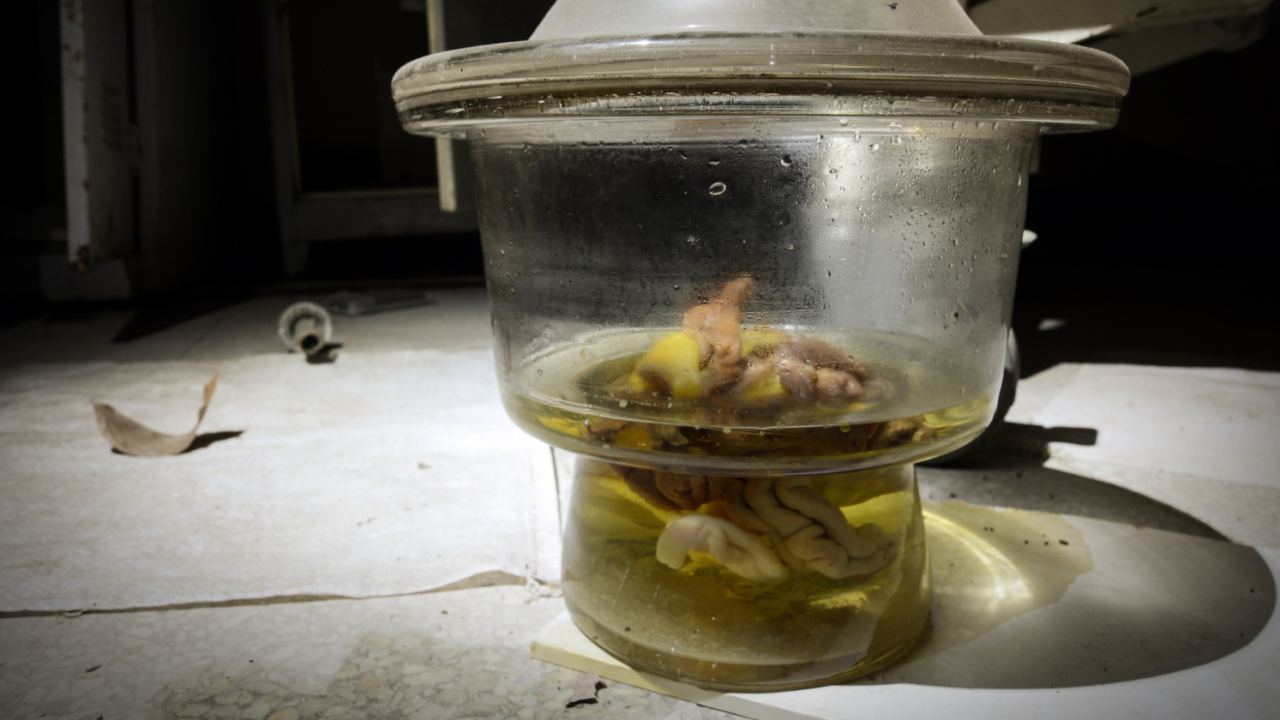
Harvey soon lost his job at the hospital. His marriage ended. He moved from place to place, including Philadelphia, Kansas and Missouri, and the brain went with him. Most of the blocks sat in jars at his home. Now and then he posted a few pieces to researchers who asked nicely.
It wasn't until 1998, 43 years after the autopsy, that Harvey handed what was left to a pathologist at Princeton's University Medical Center. About 170 of the original 240 blocks are still kept there today. Others are scattered between museums, labs and private collections, and some have simply vanished.
So was Einstein's brain small?
Not really. A brain of 1,230 grams sits comfortably within the normal human range.
Weight also tells you surprisingly little about intelligence. Brain size varies a lot from person to person, partly with body size, and brains gradually shrink with age. A 76-year-old's brain will typically weigh less than it did at 30.
So the lighter-than-average weight wasn't a clue to anything. If Einstein's brain was special, the difference would have to lie in how it was built, not how much it weighed.
What scientists thought they found
In 1999, Canadian neuroscientist Sandra Witelson studied Harvey's photographs and compared them with dozens of ordinary brains. Her team reported in The Lancet that Einstein's parietal lobes were unusual. These are regions near the top and back of the head that help with spatial thinking and maths. The researchers said they were about 15% wider than average, and that a groove which normally divides part of the region seemed to be missing.
It was a tempting story. Einstein often said he thought in pictures rather than words.
Then, in 2012, a set of Harvey's photographs that had been lost for decades turned up. Anthropologist Dean Falk and her colleagues analysed them in the journal Brain and described what they called an extraordinary prefrontal cortex, the front part of the brain involved in planning and abstract thought. Awkwardly, they also concluded that the groove Witelson thought was missing was actually there.
The case for scepticism
Not everyone was persuaded by any of it.
In 2014, psychologist Terence Hines of Pace University published a sharp critique of the major studies. His argument was simple. Every brain has its quirks, and if you study one brain knowing it belonged to a genius, you'll almost certainly find something that looks special. He compared it to seeing faces in clouds.
He suggested a fairer test. Give researchers unlabelled samples from several brains, and see whether anyone can pick out Einstein's without being told which is which.
That test has never been done. There's also a problem no study can get around. Einstein was a single person, and you can't draw firm conclusions about genius from a sample of one.
A brain that never quite rested
Einstein wanted his remains to disappear quietly. Instead, a piece of him spent four decades in jars, travelled across America and has been argued over in some of the world's most respected journals.
Whether his brain held the secret to his genius is still an open question. The uncomfortable answer may be that what made Einstein remarkable left no trace you can see under a microscope.