How you feel fear
Where you are
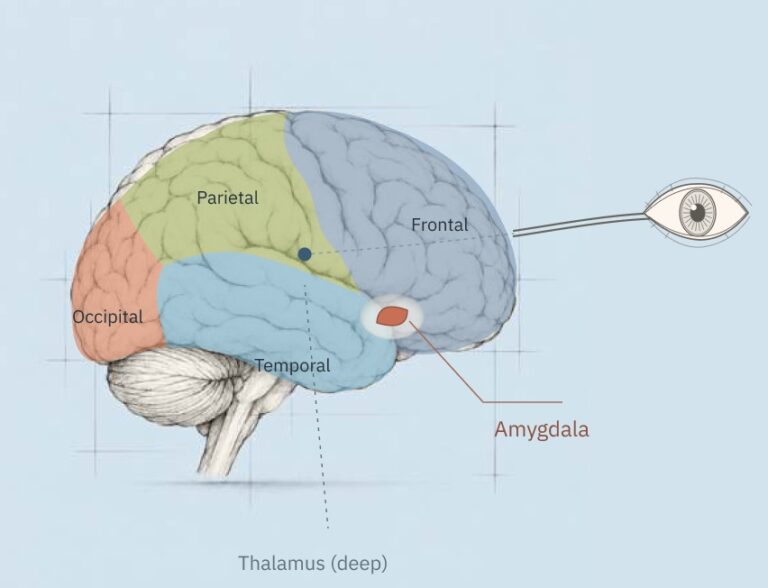
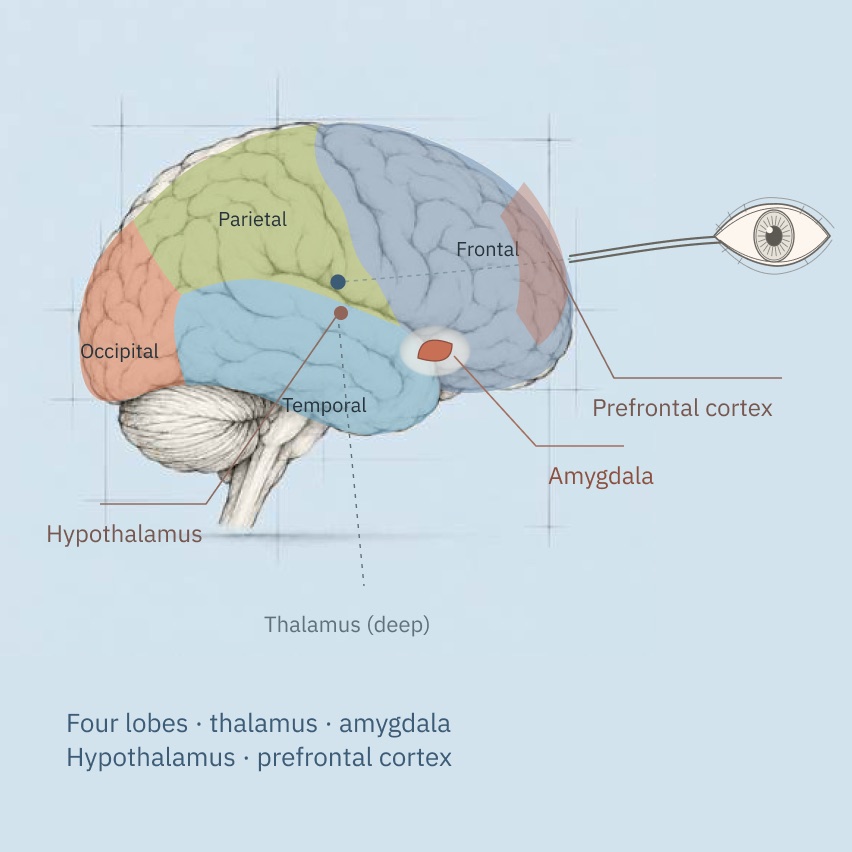
Here's your map, just as you left it. Four lobes, the thalamus as a small dot in the middle, the eye out in front. Yesterday you put a hand on the back of your head and found, roughly, where you see.
Today, touch your temple, just beside the outer corner of your eye. A few centimeters straight in from your fingertip, deep inside the temporal lobe, sits a small knot of brain about the size of an almond. The name is Greek for almond: amygdala. You have two, one behind each temple.
You've never felt it the way you feel your heartbeat, but you know its work. It's part of what sits you bolt upright at a creak on the stairs in the middle of the night, a beat before you've even wondered what made it. Do you remember the scene in lesson 1? The coat mistaken for someone standing in the corner, at 2 a.m., when you got up for a glass of water. While you were still squinting at that shape, your amygdala was already busy.
Today you'll find out how your body could be afraid before you knew what of.
The scene
Go back to that doorway, and this time play it in slow motion.
The floor is cold under your feet. The room is a few shades of grey, and in the corner there's a darker shape, about the height of a person. You haven't worked out what it is. Your eyes are still on it, trying.
Your body isn't waiting for them. Your breath catches halfway in. Your heart starts to hammer against your ribs. Your legs lock, and every muscle is ready to go, though you couldn't say where.
Then the shape sharpens. Shoulders. A head, tilted slightly forward. Now you see someone.
Your hand finds the switch. Coat.
You might say: it all happened at once. In the moment, it felt that way. But replay it, and as best you can tell, the pounding heart came first and the someone came after. Your body was ready to run from something you hadn't yet seen.
So your body was afraid of something you hadn't seen yet. To understand how, you first need to know how long seeing takes. Not at 2 a.m., in the dark. Right now, in good light. Give me two minutes and you'll have your own number.
Try it now
2 minutes
You need a screen, one finger and two minutes. The circle is what you watch. Your tap or click is the answer.
Can't use the visual test? Try the ruler test below ↓
- On a phone, hold a fingertip just above the screen, not touching it. On a computer, rest a finger on your mouse, trackpad or space bar.
- Watch the circle. When it turns green, tap or click as fast as you can.
- Do it five times. Don't guess: if you press before the green, that trial starts over.
Round 1 · 5 valid trials
- —
- —
- —
- —
- —
Average — ms
Trying to beat the green? Everyone does on the second or third go. Guessing gives you a fast number that measures nothing. Wait until you actually see it.
Look at your average. About a quarter of a second passed between the light reaching your eye and your finger pressing down. That's the simplest act you can perform: see one thing, do one thing.
Now make it a little harder. Same circle, but this time it turns either green or red. Green: tap or click. Red: do nothing.
Round 2 · 8 valid trials
- —
- —
- —
- —
- —
- —
- —
- —
Round 1 — ms Round 2 — ms Difference — ms
Compare your two averages. Most people are a few tens of milliseconds slower in the second round. Nothing changed in your eyes or your finger. The only thing added was one small decision, green or red, and your brain needed extra time to make it.
This is how the speed of a thought was first measured. In 1868 the Dutch physiologist Franciscus Donders timed people on a simple task, then on the same task with one decision added, and subtracted. The difference was the time the decision took. You just did his experiment on yourself.
Every step your brain takes costs time. You've now measured one.
One note on the numbers. Your screen and your mouse, trackpad or touchscreen each add a few milliseconds, and phones and tablets usually add more, so expect a higher score there. The delay is the same in both rounds, so the gap between them still holds.
Want another test?
This one needs no screen, just a 30 cm ruler and someone to drop it. With no screen or mouse in the way, it measures only you.
Ask someone to hold the ruler vertically, the 0 mark at the bottom. Hold your thumb and index finger open around the 0 mark, not touching it. Without warning, they let go; you pinch as soon as you see it move. Read the centimeter mark where you caught it.
| You caught it at | Your reaction time |
|---|---|
| 10 cm | about 145 ms |
| 15 cm | about 175 ms |
| 20 cm | about 200 ms |
| 25 cm | about 225 ms |
| 30 cm | about 245 ms |
What just happened
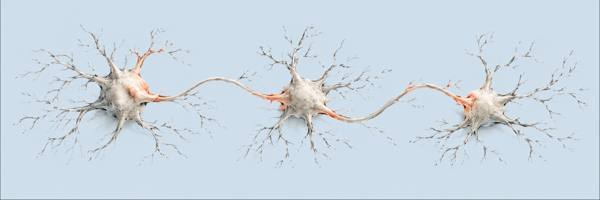
About a quarter of a second, to see one bright circle and press. Good light, nothing to work out, your finger already in place. That's the number to explain first: where did all that time go?
You might say: of course it took time. My finger is slow.
Your finger is the fast part. The command to press travels from your brain to your hand along nerves, a trip of about a meter. Even at a modest 50 meters per second, that takes around 20 milliseconds, under a tenth of your score. Almost all of the quarter second went by inside your head.
To see where it went, you need to meet what every region on your map is made of.
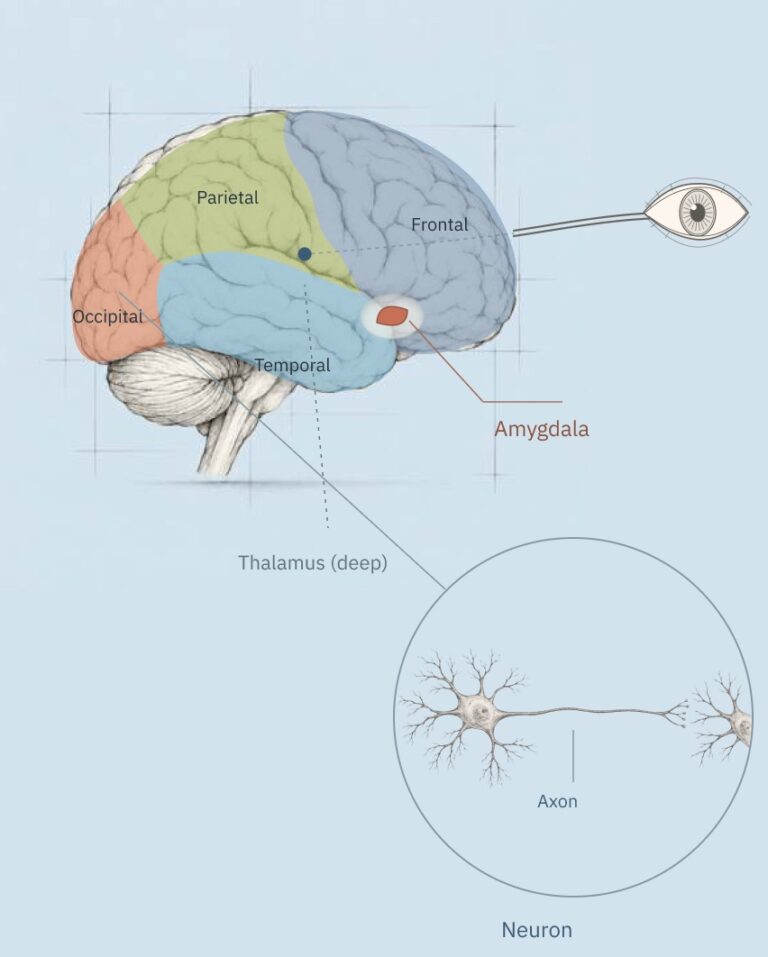
Your brain is made of about 86 billion cells called neurons. Each has short branches that collect signals from other neurons, a cell body that adds them up, and one long fiber, the axon, that carries the result away. Many axons reach no farther than a millimeter or so. The longest run from the base of your spinal cord to your big toe, a meter or more.
When the incoming signals are strong enough, the neuron fires: a pulse of electricity runs down its axon to the far end. That pulse is the signal. Every route you followed yesterday was a chain of neurons, each passing it to the next.
The pulse doesn't move like current in a copper wire, which arrives almost at once. It rebuilds itself as it goes, through tiny gates in the cell's outer skin that open one patch after another. Insulated axons carry it at up to about 150 meters per second, faster than a racing car. Bare, thin ones manage half a meter to a few meters per second, closer to walking pace.
You've felt both speeds. Stub your toe and there's a sharp, precise jolt, then a beat later a dull, spreading ache. One toe, one instant, two kinds of fiber arriving at different times.
At the end of the axon there's a gap before the next neuron, the synapse, and the signal crosses it by chemistry. You'll open that gap tomorrow. For now, one fact is enough: each handover costs time, and anything your brain does takes many handovers in a row. That's where your quarter second went. It's also why the green-or-red round was slower: one more decision means more of them.
That's the first half of the answer. Now take your number back to the doorway. Seeing one bright circle and pressing took you about a quarter of a second. At 2 a.m. the call was much harder: a dark shape, almost no light, person or not. With less to go on, that chain of handovers ran longer still. Your heart didn't wait for it. It was pounding while you were still squinting at the corner.
So what reached your heart first? Follow both jobs across your map.
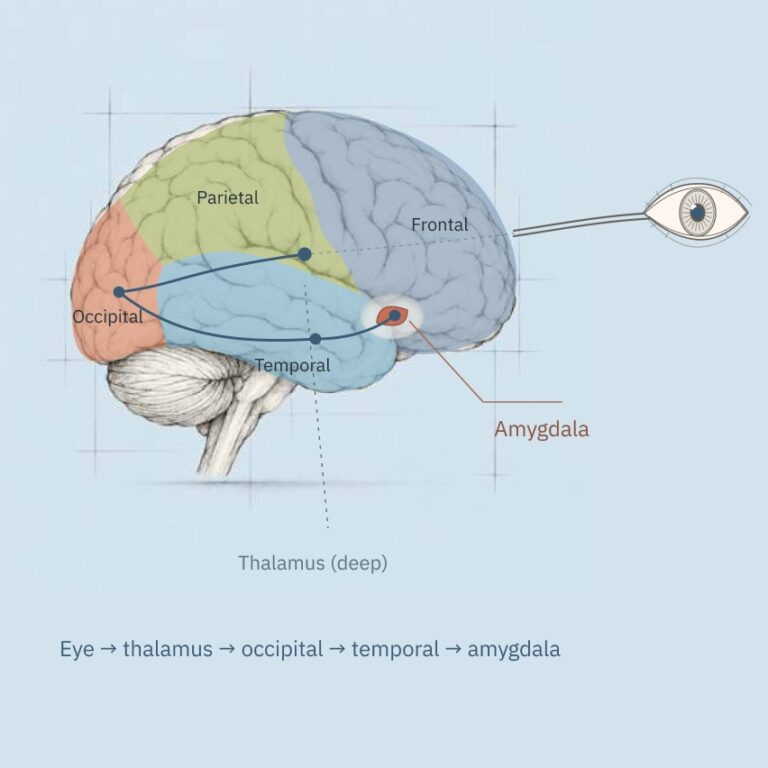
Here's that harder call, step by step. Eye to thalamus, thalamus to the back of your head, then down into the temporal lobe to work out what the shape is. Each stage is a crowd of neurons, each adding its delay. Only near the end does a finished guess, a person, reach the amygdala at the inner edge of the temporal lobe. One of the amygdala's jobs is judging whether what's in front of you is a threat. When it decides yes, it raises the alarm.
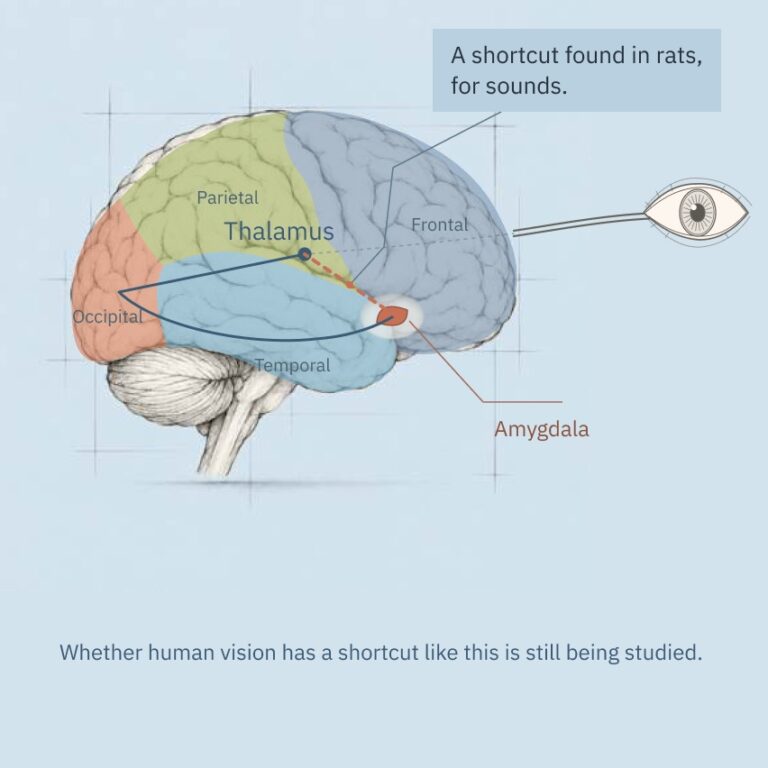
That's the long route. In the 1980s and early 1990s, the neuroscientist Joseph LeDoux and his team found a shorter one, in rats. The rats learned to fear a tone that came just before a mild shock. When the team destroyed the hearing part of the cortex, the rats still learned. A direct path from the thalamus to the amygdala could carry the sound there on its own: fewer handovers, a rougher picture, an earlier alarm.
Whether your eyes have a shortcut like that is still being studied. What's already clear is simpler: building the picture and raising the alarm are separate jobs, done in different places, and they don't have to finish at the same time.
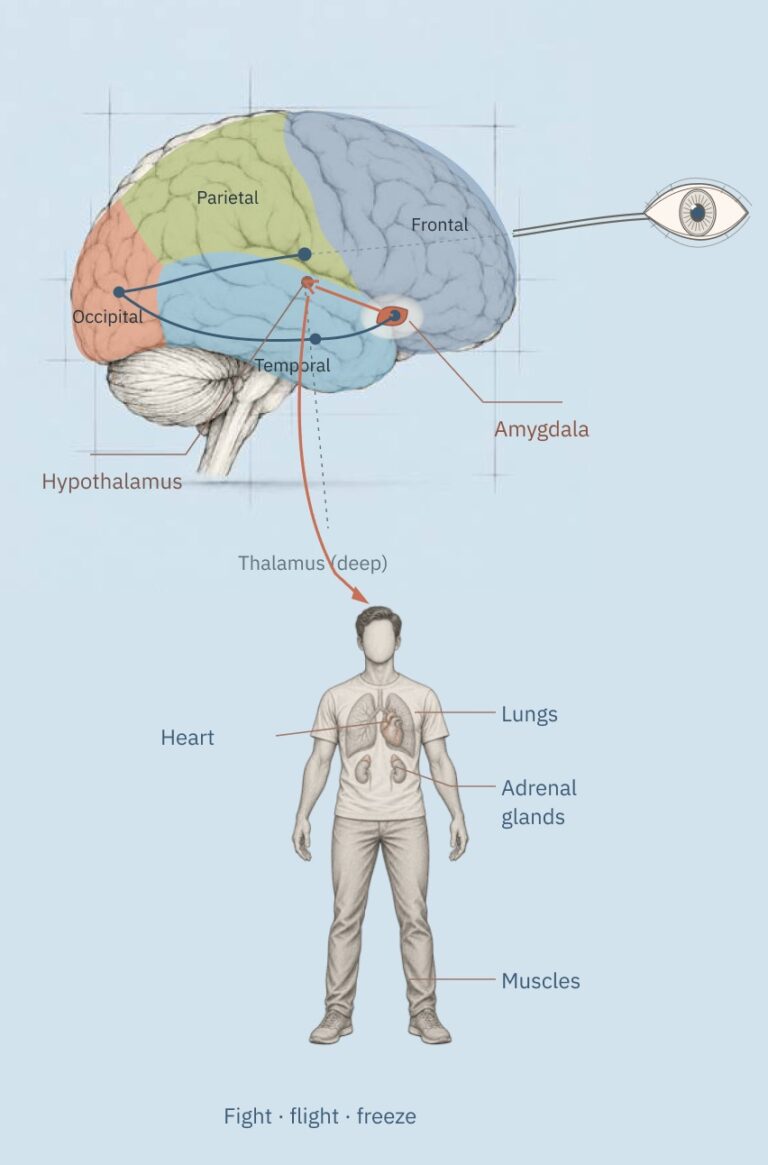
Here's what the alarm does. The amygdala signals the hypothalamus, a small region just below the thalamus that runs much of the body's automatic machinery. Through nerves, your heart speeds up, your breathing changes, your muscles brace. Through the glands above your kidneys, adrenaline pours into your blood. All of it has one purpose: to get you ready to fight or run before you know which you'll need. The heart pumps harder to push blood to your muscles, the breath pulls in more oxygen, the muscles tense so they can move at once. Often the first move is no move at all. You freeze, the way you did in the doorway, ready for whatever comes next. That's the hammering heart, the breath caught halfway, the locked legs. None of it waited for you.
Put two fingers on the side of your neck, just under your jaw, and find your pulse. Right now it's probably slow and steady. In the doorway, the hypothalamus had it racing before your hand reached the switch.
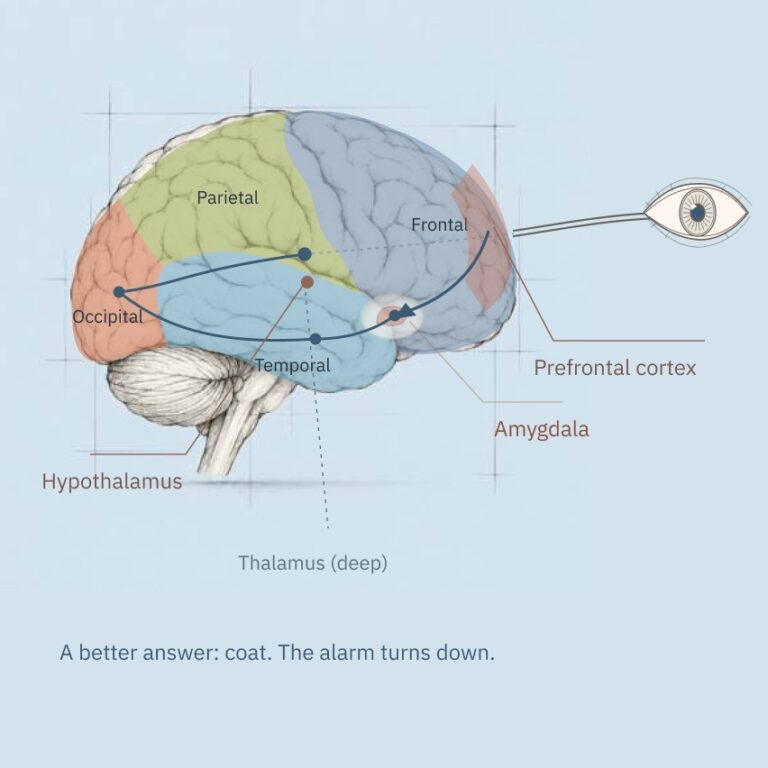
Then the light goes on, and the long route delivers a better answer: coat. Put your fingertips on your forehead. Behind them is the prefrontal cortex, the front of the frontal lobe, and it tends to be where corrections like this come from. It's strongly connected to the amygdala and can turn the alarm down. It can't take back what's already happened, though. The adrenaline is in your blood by then, which is why your heart keeps pounding after you've laughed at the coat.
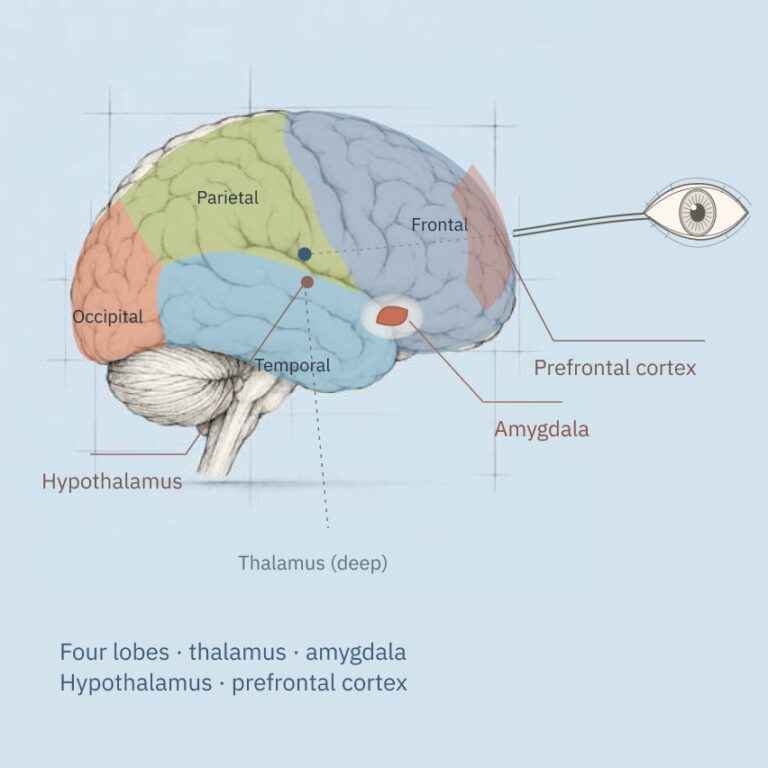
So the doorway held two jobs running at once. One built a picture, handover by handover, and needed light to get it right. The other judged danger from whatever had arrived so far and spoke straight to your body. The second got to your heart first.

A real case
The story: the woman who couldn't be scared
A woman walked into an exotic pet store with a team of neuroscientists from the University of Iowa. For years she had told them she hated snakes. Within minutes, she was holding one.
The researchers called her SM. A rare genetic condition, Urbach-Wiethe disease, had destroyed both of her amygdalae and left almost everything else intact. Her eyes worked. Her memory and intelligence tested in the normal range. She could see a snake perfectly well. She just couldn't be afraid of it.
She held the snake for more than three minutes, rubbing its scales and touching its flicking tongue. She asked fifteen times to touch the bigger ones, even after the staff warned her they could bite. She reached for a tarantula and had to be stopped. When the team asked why, she said she was curious. On a fear scale from 0 to 10, she never went above 2.
So they tried harder. At Halloween they took her to a haunted house set up in an old sanatorium. The strangers in her group screamed. SM led them through the dark corridors, laughed at the actors dressed as monsters, and poked one in the head to see what it felt like. She startled the monster. Her fear rating stayed at zero the whole way through. She said it felt exciting, like a roller coaster.
Horror film clips did nothing either. She enjoyed them and asked the name of one so she could rent it. She also said most people would find them frightening. She knew what fear was. She just never felt it.
Outside the lab, that cost her. Her history, backed by police reports, included being held up at knifepoint and at gunpoint. Afterward she felt upset and angry, but not afraid. Without the alarm, she kept walking into situations most people would have learned to avoid.
The team published her case in 2011, and it seemed to settle the question: no amygdala, no fear.
Two years later, they tried one more test. They asked SM and two other women with the same damage, a pair of identical twins, to take a single deep breath of air loaded with carbon dioxide. That breath brings on a sudden feeling of suffocation. Before the test, the healthy volunteers were nervous, sweating, their heart rates climbing. SM and the twins were completely calm.
Then they breathed in, and all three panicked. They reported more fear than most of the twelve healthy volunteers, nine of whom didn't panic at all. As far as the researchers knew, it was the first time since childhood that SM had felt fear anywhere.
Now put SM in your doorway at 2 a.m. Her eyes, her thalamus and her visual cortex all work, so she sees the shape, maybe even the person in it. What she lacks is the station where that picture becomes an alarm. Her pulse, under her jaw, stays where yours is right now.
The breath reached her because it was a different kind of threat. Hold your own breath for a moment, only as long as it's comfortable. The urge that builds isn't mainly your oxygen running low. It's carbon dioxide rising in your blood, picked up by sensors in the brainstem, at the base of your brain. That alarm starts inside the body, and it can reach fear without passing through the amygdala, probably by routes in the brainstem, below the part of the map you've drawn so far.
SM could look straight at a snake and feel nothing, yet one breath was enough to terrify her. If you tried to put fear on your map as a single spot, her case wouldn't let you. What you can draw is a route: from the eyes, through the amygdala, down to the body. It's the one you followed today, but it isn't the only one.
What you know now
Ten minutes ago, your map had four lobes and a single dot at the center. Here's what's on it now.
1. Everything on your map is made of neurons, about 86 billion of them. Each one collects signals, adds them up, and fires a pulse down its axon to the next. That pulse moves anywhere from walking pace to faster than a racing car, which is why a stubbed toe hurts twice.
2. Every handover between neurons costs time. Seeing a bright circle and pressing took you about a quarter of a second, almost all of it inside your head. One small decision, green or red, made it longer.
3. Seeing and fearing are separate jobs. The amygdala judges danger and, through the hypothalamus, readies your body to freeze, fight or run, sometimes before the picture is finished, as it was at 2 a.m. The prefrontal cortex can turn the alarm down once a better picture arrives. SM showed the split: she could see everything and fear none of it, until the threat came from inside her own body.
Check yourself
Question 1 of 3
In round 2 of the test, you were probably slower than in round 1. Why?
Your eyes and your finger did the same work in both rounds. The decision added steps inside your brain, and each step costs time.
Question 2 of 3
A friend jumps out from behind a door and shouts. You flinch, your heart pounds, then you recognize them and laugh. Your heart keeps racing for another minute. Why?
Once you recognize your friend, the prefrontal cortex turns the alarm down. But the adrenaline is already working, and your body needs time to settle, just like after the coat.
Question 3 of 3
Someone with SM's kind of damage is shown a photo of a snarling dog. What would you expect?
The route that builds the picture is intact. What's missing is the amygdala, where a threat seen out in the world tends to become fear. Carbon dioxide got through because it came from inside her body.
Go further
Want more on any stop along today's route? These Know Your Brain entries each take a few minutes and go into the detail this lesson left out. Read them now, or come back after lesson 3, when you'll know what happens in the gap between one neuron and the next.
Reference
Reference
Reference
2-minute video